
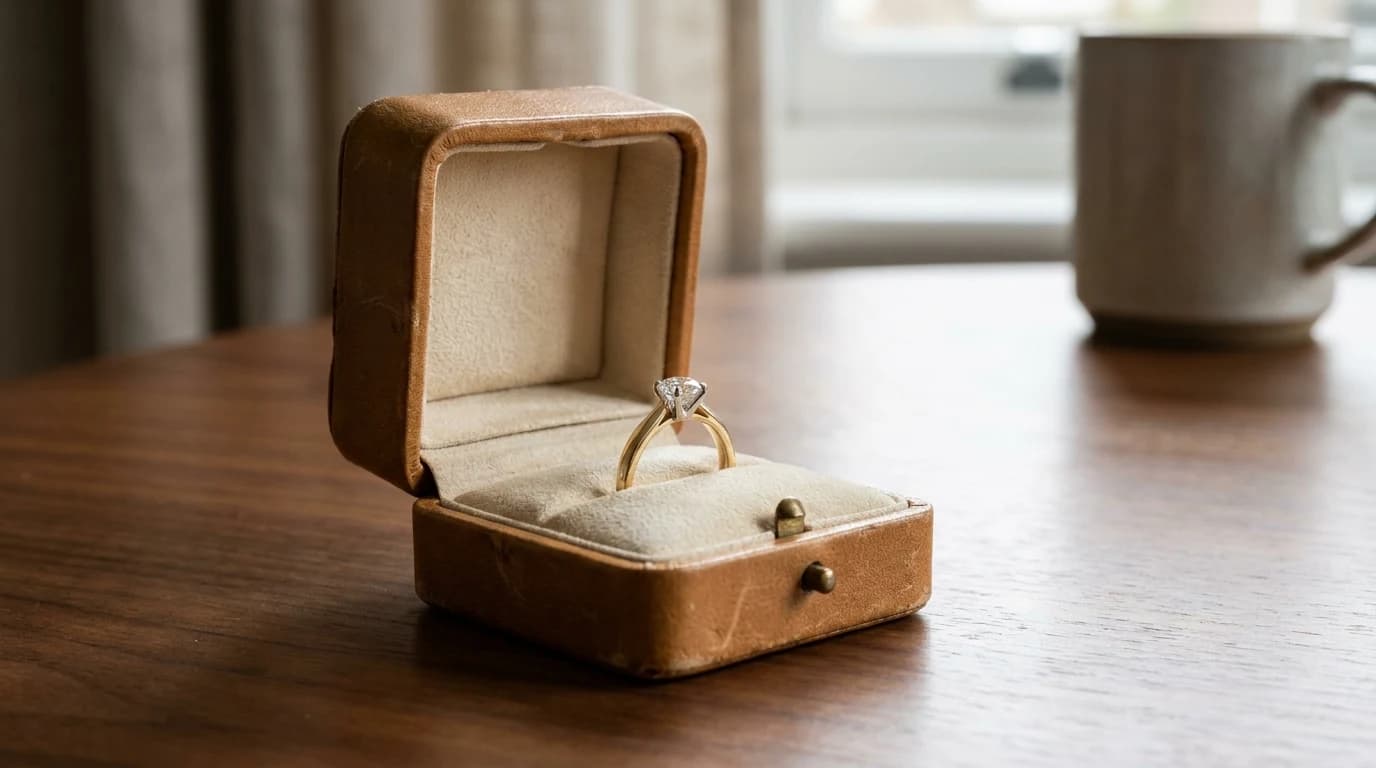
Short answer: in 2026, solid engagement rings with a lab-grown diamond in Czechia start at roughly €850 (≈ CZK 21,000) for a half-carat stone in 14k gold and rise with the size and quality of the stone. A visually identical ring with a natural diamond typically costs 3–7× more. But the final price is never a single number — it is the sum of the gold, the setting design, and above all the specific centre diamond you choose. This guide shows realistic price bands by carat and explains what actually drives the price and where the biggest savings are.
What Makes Up the Price of an Engagement Ring
The price of a finished ring breaks down into three parts: (1) the centre diamond, (2) the setting and side stones, (3) the gold and labour. For most engagement rings the centre diamond accounts for 60–85% of the total — which is why the choice of stone is the decision that moves the price the most.
The centre diamond is priced on the 4Cs (cut, colour, clarity, carat) and on origin (lab-grown vs natural). Price jumps at "magic" weights — a 1.00 ct stone is noticeably more expensive than a 0.90 ct, even though the eye can barely tell them apart.
The setting (solitaire, halo, pavé, three-stone) and side stones add cost according to the number and size of stones and the complexity of the work. A solitaire is the least expensive; halo and pavé with dozens of small diamonds push the price up.
Gold adds a relatively smaller share. 18k gold is about 30% more expensive than 14k because it contains more pure gold (75% vs 58.5%). On a typical ring, the difference between 14k and 18k is in the low hundreds of euros, not thousands.
Why Lab-Grown Is the Value Choice
A lab-grown diamond is optically, chemically, and physically identical to a mined one — same carbon, same hardness of 10 on the Mohs scale, same light performance. Only the origin differs: it grows in a reactor over weeks instead of forming in the Earth over millions of years. The U.S. Federal Trade Commission (FTC) and the major labs confirm that a lab-grown diamond IS a diamond.
The price gap, meanwhile, is dramatic. For a visually identical stone you typically pay 5–10× less for lab-grown than for natural — especially at larger carats, where natural prices climb most steeply. The table below shows a 1.00 ct lab-grown ring starting around €1,300, while a comparable natural starts around €5,500.
The practical upshot: at the same budget, lab-grown lets you choose either a noticeably larger stone or better cut and clarity. For most engagement rings, this is the best ratio of what you see to what you pay.
Kove leads with lab-grown diamonds as the primary choice; natural remains for those who value traditional origin. Both come with IGI, GIA, or HRD certification and in 14k as well as 18k gold.
How Much to Spend — Budget Orientation
Forget the old "two to three months' salary" rule. In Czechia in 2026, most people choose based on what makes sense for their situation, not on a formula.
Up to CZK 30,000 (≈ €1,200): a very attractive lab-grown solitaire of 0.5–0.7 ct in 14k gold, eye-clean, Excellent cut. Entry level with a full-looking appearance.
CZK 30,000–60,000 (≈ €1,200–2,400): a lab-grown diamond of 1.0–1.3 ct, 18k gold, optionally with a delicate halo or pavé. The most common choice in Czechia.
CZK 60,000–120,000 (≈ €2,400–4,800): a larger lab-grown stone (1.5–2.0 ct) with a premium setting, or a smaller natural diamond (0.5–0.7 ct) for those who insist on mined origin.
CZK 120,000 and up: statement rings — a large natural diamond or an exceptional 2 ct+ lab-grown stone with an elaborate design.
Illustrative Prices by Carat (2026)
The table below gives typical starting bands for a finished ring (setting + centre diamond) in Czechia. The figures are illustrative guidance, not a fixed price list. The final price always depends on the specific certified diamond (cut, colour, clarity) and the chosen setting. See current live prices in the configurator.
| Carat | Gold | Lab-grown (from) | Natural (from) |
|---|---|---|---|
| 0.50 ct | 14k | from €850 (≈ CZK 21,000) | from €1,900 (≈ CZK 47,500) |
| 0.50 ct | 18k | from €950 (≈ CZK 23,500) | from €2,200 (≈ CZK 55,000) |
| 1.00 ct | 14k | from €1,300 (≈ CZK 32,500) | from €5,500 (≈ CZK 137,500) |
| 1.00 ct | 18k | from €1,500 (≈ CZK 37,500) | from €6,000 (≈ CZK 150,000) |
| 1.50 ct | 14k | from €2,100 (≈ CZK 52,500) | from €11,000 (≈ CZK 275,000) |
| 1.50 ct | 18k | from €2,400 (≈ CZK 60,000) | from €12,000 (≈ CZK 300,000) |
| 2.00 ct | 14k | from €3,200 (≈ CZK 80,000) | from €22,000 (≈ CZK 550,000) |
| 2.00 ct | 18k | from €3,600 (≈ CZK 90,000) | from €24,000 (≈ CZK 600,000) |
Bands assume an eye-clean, well-cut stone and a simple-to-modest setting. Halo, pavé, and three-stone designs increase the price. The CZK/EUR rate is rounded (≈ CZK 25/€); actual conversion follows the daily ČNB rate. These are not specific Kove SKU prices.
Frequently Asked Questions
Summary — Key Takeaways
Engagement-ring prices in Czechia in 2026 start at roughly €850 (≈ CZK 21,000) for lab-grown and rise with the size and quality of the stone; natural diamonds cost several times more for the same look. The centre diamond and the lab-vs-natural choice have the biggest effect on price; gold (14k vs 18k) plays a smaller role. Lab-grown offers the best ratio of what you see to what you pay. The final price is always set by the specific stone and setting — build yours in the live configurator.
Still not sure? Just ask a real person.
Tell us your idea and your budget — we answer personally and spec the best certified diamond for you, with its IGI or GIA certificate. No pressure, no obligation, no checkout.