
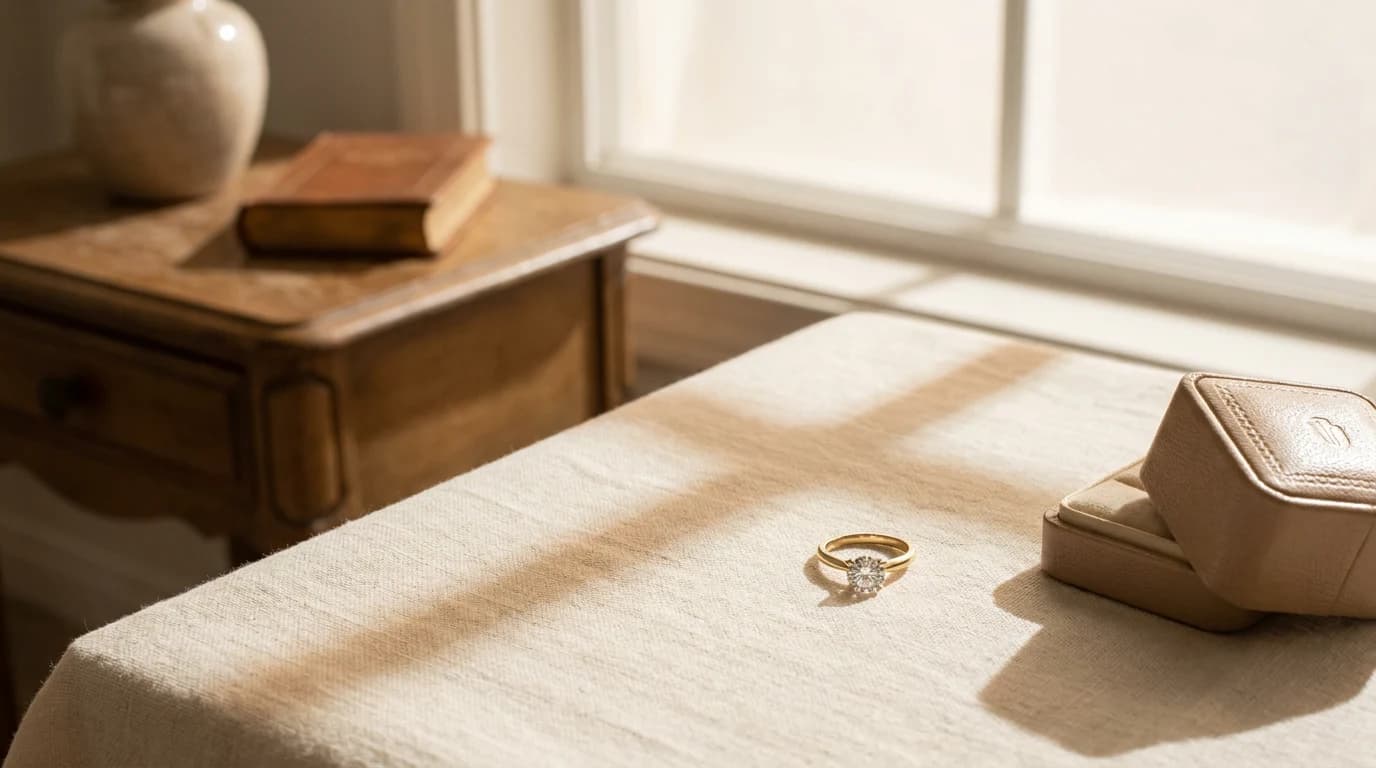
An engagement ring is still one of the most significant single purchases most people make. This guide covers everything you actually need to know before placing an order in the Czech market: realistic price bands in CZK, how to choose between lab-grown and natural diamonds, what the 4Cs really mean, how to discreetly find your partner's ring size, how Czech VAT and proforma invoicing work, and why made-to-order production takes 10–28 business days.
1. Engagement Ring Budget in Czechia
In 2026, Czech engagement-ring prices fall into broad bands depending on stone and metal:
• Entry-level (0.30–0.50 ct, lab-grown, 14k gold): CZK 15,000–35,000 (≈ €600–1,400). Good size-to-price ratio, suited for daily wear.
• Standard engagement ring (0.70–1.00 ct, lab-grown, 18k gold): CZK 35,000–80,000 (≈ €1,400–3,200). The most common choice in Czechia in 2026.
• Natural diamond 0.70–1.00 ct, 18k gold: CZK 80,000–180,000 (≈ €3,200–7,200). Same size as the lab-grown band, traditional origin.
• Statement ring (1.50 ct+, natural, 18k gold): CZK 200,000+ (≈ €8,000+). Investment-tier.
Plan the budget including 21% VAT — Czech retailers quote either VAT-included (B2C) or VAT-excluded (B2B). If you buy on an IČO (Czech business ID), VAT is deductible, but a personal-gift classification then no longer applies.
2. Lab-Grown vs Natural — What Czech Buyers Choose Today
A lab-grown diamond is optically, chemically, and physically identical to a mined diamond. The only difference is origin — grown in a reactor over weeks instead of formed in the Earth over millions of years. Under a 10x loupe, on a gemological instrument, or with the naked eye, you cannot distinguish a well-cut lab-grown from an equally-cut natural.
In 2026, more Czech buyers choose lab-grown for two reasons: (1) it costs 60–80% less per carat than equivalent natural quality, freeing budget for a larger, better-cut stone; (2) lower environmental and ethical footprint — no surface mining, no conflict-zone supply chain.
Natural diamonds remain the choice of buyers who value traditional provenance and view the ring as a future heirloom. From an investment angle: small natural diamonds (under 1 ct) do not hold value well as investments; large naturals (2 ct+) hold value more reliably.
Kove's default recommendation for most engagement rings: a lab-grown diamond with IGI or GIA certification. Same budget, dramatically more carat, better cut and clarity available.
3. The 4Cs — What Actually Matters
Every diamond is graded on four factors — Cut, Color, Clarity, Carat. The practical priority order:
Cut is the most important. A poorly cut diamond does not return light to the eye — it looks dull regardless of size and clarity. Never buy below "Very Good"; if budget allows, always choose "Excellent". Cut is the only one of the 4Cs created by human craft and has the biggest effect on how the ring actually looks.
Color is graded D (completely colorless) to Z (visibly yellow). For an engagement ring, G or H is the sweet spot — visually indistinguishable from D once set in metal, but 20–30% cheaper.
Clarity measures inclusions under 10x magnification. "Eye-clean" means no visible inclusions at normal viewing distance — VS2 and cleaner is reliably eye-clean, SI1 usually is. VVS and Flawless grades are invisible even under magnification and represent overpaying for the typical buyer.
Carat is weight, not size. 1 carat = 0.2 grams. A 0.90 ct round measures ~6.2 mm, a 1.00 ct ~6.5 mm — visually almost identical. Prices jump at "magic" weights (1.00, 1.50, 2.00 ct), so a 0.90 ct can be dramatically cheaper than a 1.00 ct of identical quality.
4. Centre Stone Shape — Czech Preferences
The dominant choice in Czechia is the round brilliant — the classical 57-facet cut with maximum light return. Around 60% of all sold engagement rings.
Second place is the oval — visually elongates the finger, looks larger than a round of equal weight, and flatters most hands. Its share is growing in 2026, especially among younger buyers.
Emerald cut is rectangular with step facets — elegant, Art Deco aesthetics. Requires higher clarity (VS2 or better) because its open facets reveal every inclusion.
Cushion combines softly rounded corners with brilliant faceting — romantic, vintage feel.
Less common but distinctive: pear, marquise, heart, princess, asscher (square step-cut), radiant. Each shape behaves optically differently — round has the most brilliance, emerald the most architectural elegance.
5. Gold — 14k vs 18k and Colour
14-karat gold (585/1000) contains 58.5% pure gold. Harder, more scratch-resistant, ~30% cheaper than 18k. Suited for daily wear and active lifestyles.
18-karat gold (750/1000) contains 75% pure gold. Richer, warmer colour and higher prestige value. Softer, develops a fine-scratch patina faster. The standard for luxury engagement rings.
White gold — an alloy with palladium (EU regulation bans nickel due to allergy risk), rhodium-plated for maximum whiteness. The classical choice for most Czech buyers; plan to refresh the rhodium plating every 2–3 years.
Yellow gold — traditional warm colour. Strong cultural attachment in Czechia (gold-as-investment culture, family-jewelry inheritance). Making a comeback in 2026 after a decade of white-gold dominance.
Rose gold — alloyed with copper, gentle pink hue. Romantic choice, complements lighter skin tones well.
6. Ring Size — How to Find It Discreetly
European ring size is the inner circumference in millimetres. The average Czech woman wears EU 53–55 on the ring finger; the average Czech man wears EU 60–63.
Three discreet ways to determine your partner's size:
• Borrow an existing ring (any from the left-hand ring finger) and measure its inner diameter in mm — diameter × π = circumference (e.g. 17 mm × 3.14 = 53.4 mm = EU size 53).
• Press the ring into a layer of soap or plasticine and measure the impression.
• Ask a friend or sibling of your partner — someone close usually knows, or can ask under a pretext ("I need a new ring, would you help me pick the size?").
Most reputable Czech jewelers (including Kove) offer one complimentary resize within ±2 sizes during the 30 days after delivery. If you land within ±1 size, the resize is quick and preserves the design.
7. Certificates — GIA, IGI, or HRD
A certificate is an independent grading document from a gemological laboratory confirming the 4Cs. Without one, you are buying on the seller's word.
GIA (Gemological Institute of America) — the global gold standard since 1953. Strictest grading, highest secondary-market trust. For natural diamonds 0.30 ct and up, GIA is the default.
IGI (International Gemological Institute) — Antwerp-based, dominant for lab-grown diamonds. In 2026 it certifies the majority of lab-grown stones on the market. IGI and GIA grade on the same scale, but IGI tends to be one grade more lenient on colour and clarity.
HRD (Hoge Raad voor Diamant) — Belgian, the European standard. Less common at retail level but respected for higher tiers.
When receiving the ring, always verify: (1) laser-inscribed certificate number on the diamond's girdle (visible under a 10x loupe), (2) match between the certificate 4Cs and the invoice, (3) match on weight and millimetre dimensions.
8. Payment and Invoicing in Czechia
Most reputable Czech online jewelers (Kove included) offer two payment paths: card payment online (Stripe / GoPay) or bank transfer against a proforma invoice.
Card payment is instant — production begins minutes after confirmation. Stripe accepts all Czech debit and credit cards, Apple Pay, and Google Pay.
Bank transfer via proforma invoice is popular with corporate buyers and B2B purchases. A proforma is not a tax document — it is a payment request. After the funds clear, you receive a proper VAT invoice at 21%.
For companies: if buying on a Czech business ID (IČO) and want VAT deduction, request an invoice with your IČO and DIČ (VAT ID). The jeweler must provide it. Be aware — if the ring is classified as a representational expense or gift, VAT deduction may be limited by tax law.
CZK/EUR conversion: most Czech jewelers selling internationally (Kove included) let you pay in either currency. Conversion follows the daily ČNB rate.
9. Made-to-Order — Why 10–28 Business Days
Most serious Czech jewelers (Kove included) sell rings made-to-order — no wholesale stock, each ring crafted after you order. Why: every engagement ring has a unique combination of shape, size, karat, gold colour, diamond type, and engraving. Stocking every combination would be economically impossible.
A typical made-to-order timeline for a solitaire in Czechia:
• Days 1–3: centre diamond reserved, 3D-printed wax model produced, CAD file prepared.
• Days 4–15: gold casting, base setting polished, side stones (pavé, halo) set.
• Days 16–23: centre diamond mounted, quality control, engraving (if requested), final polish and rhodium plating (white gold).
• Then insured shipping by courier (DHL Express, FedEx) — delivery in 1–3 business days. When the chosen centre stone is already in local stock the first phase collapses and finished rings have shipped in as little as 10 business days.
Some complex custom rings (vintage reconstructions, family-stone integration) can take 6–8 weeks. Always ask for the specific timeline at order and get it in writing.
10. After Purchase — Insurance, Cleaning, Maintenance
Insurance: an engagement ring with a diamond above CZK 50,000 (≈ €2,000) is worth insuring. Most Czech insurers (Generali, Kooperativa, Allianz, ČSOB Pojišťovna) offer valuables insurance either as part of household coverage or as a standalone clause. Request a gemological appraisal at the time of purchase — ideally from an accredited gemological laboratory, not the retailer.
Home cleaning: soak the ring for 20 minutes in warm water with a few drops of dish soap, brush gently with a soft toothbrush, rinse and dry with a clean cloth. Do this every 2–3 weeks.
Professional cleaning: once a year, bring the ring to your jeweler for ultrasonic cleaning and a setting check (to ensure no prong has loosened). Kove offers this service free of charge to its clients.
Avoid: chlorinated pool water (damages white-gold rhodium plating), removing the ring by force (deforms the head setting), contact with perfumes and cosmetics before they have fully dried.
Future resizing: if your partner's ring size changes over time (typically ±1–2 sizes over a lifetime), your jeweler can resize the ring. Simple solitaires are quick and inexpensive to resize; pavé-band rings cost more because some stones need to be reset.
Summary — Checklist Before Ordering
Before placing your engagement-ring order, have clarity on six things: (1) budget including VAT, (2) lab-grown vs natural choice, (3) carat size and shape, (4) gold karat and colour, (5) your partner's ring size, (6) realistic 10–28 business-day timeline plus delivery. With these six decisions made, the actual ordering process at any serious Czech jeweler — Kove or otherwise — goes smoothly.
Still not sure? Just ask a real person.
Tell us your idea and your budget — we answer personally and spec the best certified diamond for you, with its IGI or GIA certificate. No pressure, no obligation, no checkout.