
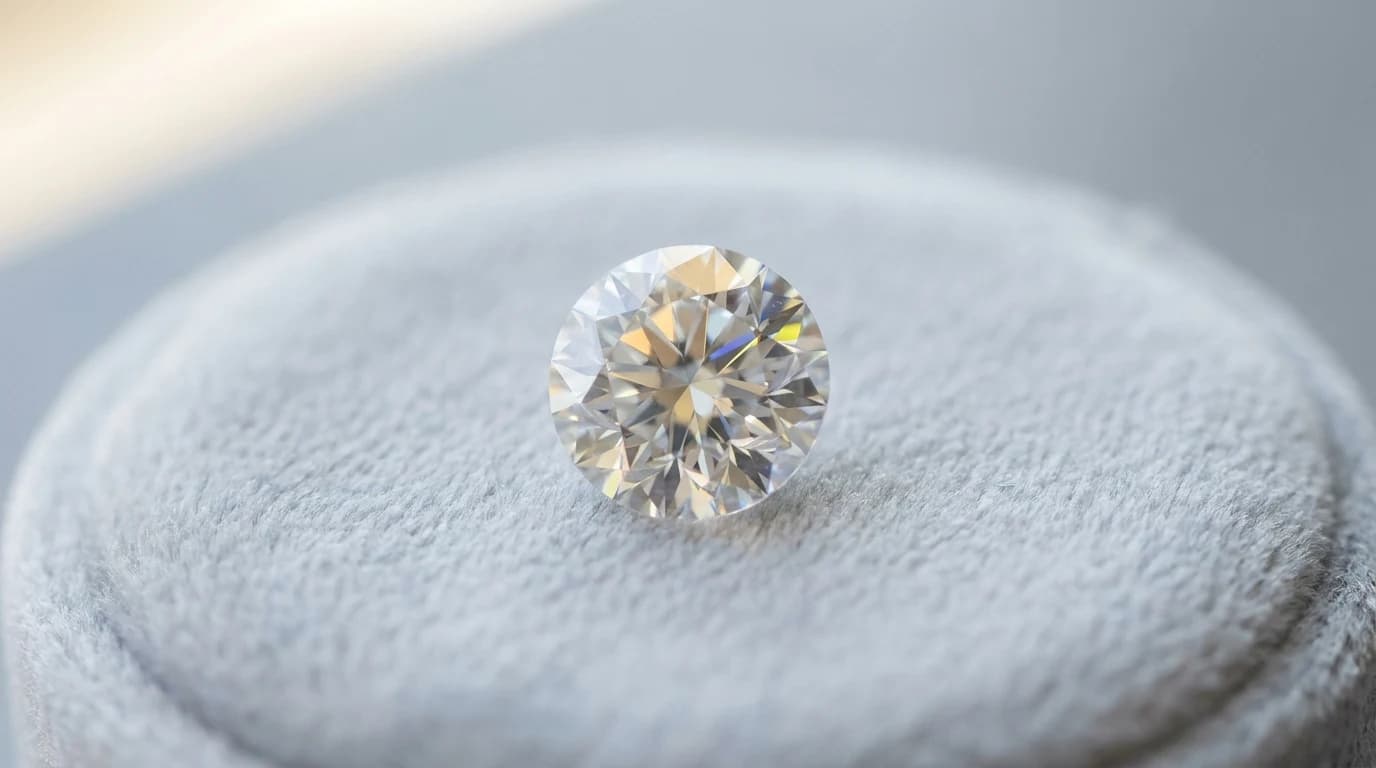
Yes — lab-grown diamonds are real diamonds. They have exactly the same chemical, optical, and physical properties as diamonds mined from deep in the Earth: the same pure carbon, the same hardness of 10 on the Mohs scale, the same light refraction and the same fire. The only difference is origin — a lab-grown diamond grew in a reactor over weeks, while a natural one formed in the Earth over millions of years. In 2018, the U.S. Federal Trade Commission (FTC) officially removed the word "natural" from the definition of a diamond precisely because a lab-grown stone is materially identical. It is graded by the same laboratories (IGI, GIA) on the same 4Cs scale. So this is not an imitation like cubic zirconia or moissanite — it is a genuine diamond, simply of a different origin.
Real Diamond vs Imitation — Where the Line Is
It is important to separate two terms that are often confused. A lab-grown diamond is a real diamond. By contrast, cubic zirconia (CZ) and moissanite are imitations — they look similar but are made of a different material and have different physical properties.
Cubic zirconia is zirconium dioxide, with a hardness of only ~8 on the Mohs scale; it abrades and loses its lustre over time. Moissanite is silicon carbide, hardness ~9.25, with a more pronounced "rainbow" fire that gives it away. Neither IS a diamond.
A lab-grown diamond, on the other hand, is carbon in the same crystal lattice as a natural diamond. A gemologist cannot tell it from natural with the naked eye or a standard tester; identifying the origin requires specialised laboratory equipment (such as luminescence analysis). For you as the wearer, it is a diamond in every respect.
How Lab-Grown Diamonds Are Made
There are two methods, both producing a real diamond. HPHT (High Pressure High Temperature) mimics conditions in the Earth's mantle — extreme pressure and temperature that convert carbon into diamond around a tiny seed crystal.
CVD (Chemical Vapor Deposition) builds the diamond atom by atom from a carbon gas in a vacuum chamber. This method dominates jewelry-stone production today because it allows precise quality control.
The resulting crystal is then cut and polished exactly like a natural diamond. The whole process from seed to polished stone takes a matter of weeks — which is why a lab-grown diamond is cheaper, not "lesser".
Are Lab-Grown Diamonds Worth It?
For most buyers, yes. For a visually identical stone you typically pay 60–80% less than for natural — sometimes 5–10× less at larger carats. That means your budget buys either a noticeably larger stone or better cut, colour, and clarity.
What to weigh on the other side: lab-grown diamonds have lower resale value, and their prices have been falling in recent years as production capacity grows. If you are buying a ring primarily as an "investment", a large natural diamond (2 ct+) holds value better. For an engagement ring that is worn rather than sold, this consideration is secondary.
On ethics and origin, lab-grown is a clean choice: no surface mining, traceable provenance, no conflict zones. For many buyers in 2026 this matters as much as price.
Kove's recommendation: for most engagement rings, a lab-grown diamond is the best ratio of what you see to what you pay. We offer natural diamonds for those who value traditional origin and rarity. Both come with IGI, GIA, or HRD certification and in 14k as well as 18k gold.
Lab-Grown vs Natural Diamond — Comparison
The table summarises where the two stones are identical and where they differ. The key point: materially and optically they are the same; the difference is origin, price, and resale value.
| Attribute | Lab-grown | Natural |
|---|---|---|
| Composition | Pure crystalline carbon | Pure crystalline carbon |
| Hardness (Mohs) | 10 (hardest) | 10 (hardest) |
| Optical properties | Identical (refraction, fire, brilliance) | Identical |
| Formation | HPHT or CVD, in weeks | In the Earth's mantle, over millions of years |
| 4Cs grading | IGI, GIA — same scale | GIA, IGI, HRD — same scale |
| Certification | Yes (laser inscription, report) | Yes (laser inscription, report) |
| Price per carat | 60–80% lower | Higher (driven by rarity) |
| Resale value | Lower, trending down | Higher for 1 ct+ stones |
| Ethics and origin | No mining, traceable origin | Depends on supply chain |
Related Guides
Frequently Asked Questions
Conclusion
Lab-grown diamonds are real diamonds — materially, optically, and physically identical to mined ones, certified by the same laboratories on the same 4Cs scale. Only origin and price differ. For most engagement rings they are the best choice: at the same budget you get a larger or higher-quality stone, with a clean ethical origin. Natural diamonds remain for those who value traditional rarity. Build your ring with a lab-grown or natural diamond in our configurator.
Still not sure? Just ask a real person.
Tell us your idea and your budget — we answer personally and spec the best certified diamond for you, with its IGI or GIA certificate. No pressure, no obligation, no checkout.