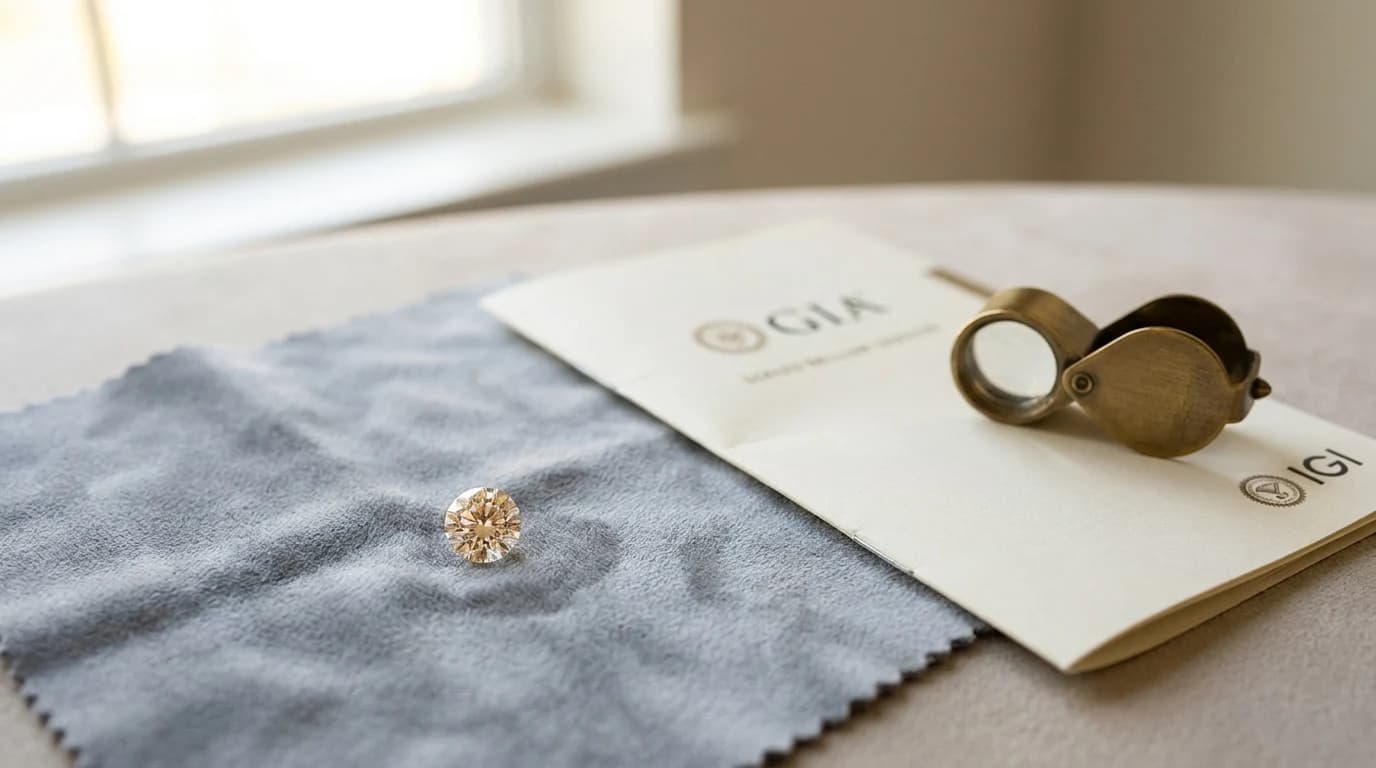
Short answer: both certificates are credible. GIA and IGI are reputable, independent gemological laboratories accredited to ISO/IEC 17025, and both grade diamonds on the same 4Cs scale. GIA (Gemological Institute of America) is traditionally regarded as the strictest and most widely recognised worldwide — it is the lab that created the 4Cs system. IGI (International Gemological Institute) is today the market leader in grading lab-grown diamonds and is effectively the standard for them. The difference is not that one is "real" and the other "fake" — it is a matter of nuance in strictness, focus, and price. This guide explains when you will see each certificate and how to read it. Kove accepts GIA, IGI, and HRD certificates and lists the certificate for every stone.
What a Certificate Actually Is
A certificate (more precisely a "grading report") is an independent document that a gemological laboratory issues after examining a specific diamond. It states the stone's 4Cs — cut, colour, clarity, and carat — along with exact dimensions in millimetres, proportions, fluorescence, and, for most stones, a plot of the inclusions.
Without a certificate, you are buying on the seller's word. With one, you have a portable, verifiable record: the report number can be checked online on the lab's own website, and for most stones the same number is laser-inscribed on the girdle (visible under a 10x loupe).
Important: a certificate grades properties, not price. Two stones with identical 4Cs from the same lab should command comparable prices regardless of where you buy them.
GIA — The Global Benchmark
GIA created the modern 4Cs system in the 1950s and remains the reference against which others are measured. It grades the most strictly and consistently; when GIA says "colour G, clarity VS1", it holds up reliably.
Historically GIA focused on natural diamonds and is still the preferred choice for them, especially for larger and investment stones where it carries the highest secondary-market trust. GIA today also grades lab-grown diamonds on the full 4Cs scale.
The price of prestige: a GIA-certified stone tends to cost more than the same stone certified by another lab — part of the price buys the certainty of the strictest, most recognised grading.
IGI — The Standard for Lab-Grown
IGI is headquartered in Antwerp and is the largest laboratory in the world by volume of stones graded. In the lab-grown segment it is the clear leader — the vast majority of lab-grown stones on the market carry an IGI certificate.
IGI grades on the same 4Cs scale as GIA. In practice it tends to be a fraction of a grade more lenient on colour and clarity, so a direct comparison of "IGI G" and "GIA G" may not be exactly identical — which is why you should always compare stones with the same type of certificate.
For a lab-grown diamond buyer, IGI is the practical and economical choice: a standard, verifiable report at a reasonable price, exactly where lab-grown stones are most plentiful.
HRD — The European Laboratory
HRD (Hoge Raad voor Diamant) is a Belgian laboratory from Antwerp, the historic centre of the diamond trade. It is well established and respected in Europe and grades strictly, close to GIA's level.
You will encounter HRD less often than GIA or IGI on everyday retail rings, but for higher tiers and in the European market it is a fully valid, accredited choice.
Kove accepts HRD certificates on the same footing as GIA and IGI — all three are accredited to ISO/IEC 17025.
Which Certificate to Choose
A practical rule: for a lab-grown diamond, IGI is perfectly fine and is the prevailing standard. For a natural diamond, especially a larger or investment one, it makes sense to insist on GIA for the strictest grading and highest resale value. HRD is a fully valid alternative in Europe.
What matters more than the lab's brand: always compare stones with the same type of certificate (GIA with GIA, IGI with IGI). Comparing "IGI G VS1" with "GIA G VS1" can be misleading due to small differences in strictness.
When you receive the stone, check three things: (1) the report number verifies online on the lab's website, (2) the laser inscription on the girdle matches the certificate, (3) the 4Cs and millimetre dimensions match the invoice.
GIA vs IGI vs HRD — Comparison
The table summarises the main differences between the three labs you will encounter in Czechia. All three are accredited and grade on the 4Cs scale; they differ in focus, strictness, and effect on price.
| Criterion | GIA | IGI | HRD |
|---|---|---|---|
| Full name | Gemological Institute of America | International Gemological Institute | Hoge Raad voor Diamant (Antwerp) |
| Founded | 1931 | 1975 | 1973 |
| Main focus | Natural diamonds, research | Lab-grown diamonds, jewelry | European market, natural & lab |
| Lab-grown grading | Yes, full 4Cs scale | Yes, market leader for lab-grown | Yes |
| Grading strictness | Strictest, most consistent | Slightly more lenient on colour/clarity | Strict, close to GIA |
| International recognition | Highest worldwide | High, dominant for lab-grown | High in Europe |
| Accreditation | ISO/IEC 17025 | ISO/IEC 17025 | ISO/IEC 17025 |
| Effect on price | Usually a price premium for GIA | Standard for lab-grown, good value | Comparable to GIA in the EU |
Frequently Asked Questions
Conclusion — Which Certificate to Trust
GIA and IGI are both trustworthy, accredited laboratories grading on the same 4Cs scale; HRD is a fully valid alternative in Europe. GIA is the strictest and best suited to natural and investment stones; IGI is the standard for lab-grown diamonds. The key is to compare stones with the same type of certificate and always verify the report number. Kove accepts GIA, IGI, and HRD and lists the certificate for every stone — browse our inventory or build a ring in the configurator.
Still not sure? Just ask a real person.
Tell us your idea and your budget — we answer personally and spec the best certified diamond for you, with its IGI or GIA certificate. No pressure, no obligation, no checkout.