
Kove Jewelry
Ring Size Guide: How to Find Your Perfect Fit
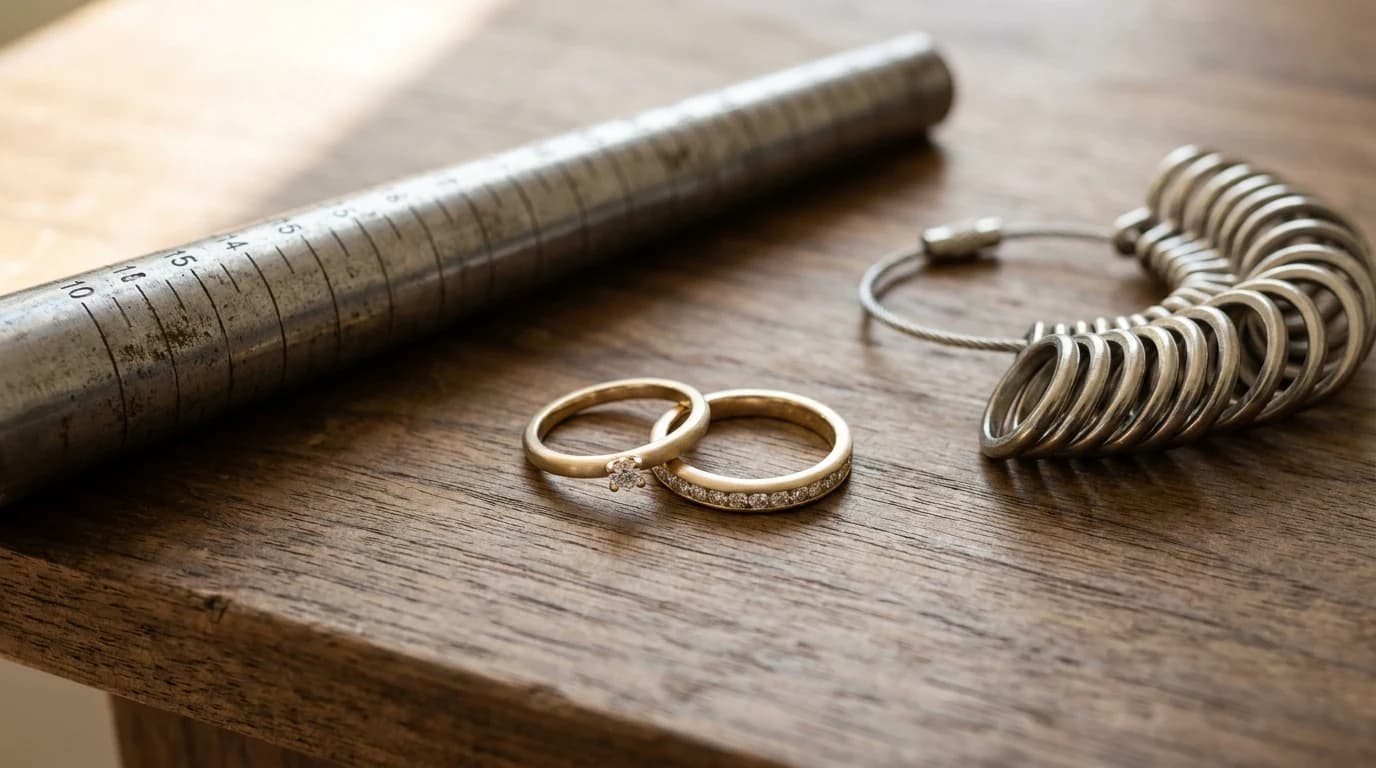
A well-fitting ring should slide on smoothly and need a gentle push to come off over the knuckle. Get it right and you forget you are wearing it; get it wrong and the piece either spins, slips off, or pinches. This guide walks through three accurate at-home methods, a full international conversion table, and the small details that jewellers use to dial in the fit.
Why Sizing Accuracy Matters
A ring that is half a size too large can spin and slip off without warning. Half a size too small and it will not pass the knuckle, or it will trap moisture and pinch the finger over the day. Beyond comfort, sizing affects cost: a standard solitaire can usually be resized once or twice within a couple of sizes, but channel-set, full-eternity, and pavé-all-around designs often cannot be resized at all without rebuilding the ring. Getting the size right the first time avoids unnecessary handling of the setting and protects the longevity of the piece.
Method 1: The String or Paper Strip
You only need a strip of paper (or a piece of non-stretchy string) and a ruler with millimetre markings. (1) Cut a strip about 8 cm long and 5 mm wide. (2) Wrap it around the base of the intended finger, snug but not tight. (3) Mark the point where the strip overlaps with a pen. (4) Lay it flat and measure the length in millimetres from the start to your mark. The number you read is your finger circumference in millimetres, which equals your EU ring size (e.g. 54 mm = EU 54). For best accuracy, repeat three times and take the average.
Method 2: Measure an Existing Ring
If you already own a ring that fits the same finger comfortably, measure its inside diameter. (1) Place the ring on a flat surface. (2) Use a ruler or digital caliper to measure across the inner edge, from one inside wall to the other, through the centre. (3) Record the measurement in millimetres. Then match that number to the diameter column in the conversion table below. This method is the most precise of the three because it removes the variable of finger swelling on the day of measurement.
Method 3: Printable Ring Sizer
A printable ring sizer is a paper template with circles of known diameters or a strip with marked size notches. Print the template at 100% scale (no fit-to-page), then verify the printed scale against a ruler before using it. Either place an existing ring over the printed circles to find the matching diameter, or wrap the printed strip around your finger and read the size where the arrow lines up. This is the method most jewellers send by post when remote sizing is needed.
International Ring Size Conversion Table
EU sizing is based directly on the inner circumference of the ring in millimetres. US and UK use their own scales. Diameter is the straight-line measurement across the inside of the ring; circumference is the measurement around the inside.
| EU | US | UK | Diameter (mm) | Circumference (mm) |
|---|---|---|---|---|
| 44 | 3 | F | 14.0 | 44.0 |
| 45 | 3¼ | F½ | 14.3 | 45.0 |
| 46 | 3¾ | G½ | 14.6 | 46.0 |
| 47 | 4 | H | 15.0 | 47.1 |
| 48 | 4½ | I | 15.3 | 48.0 |
| 49 | 4¾ | J | 15.6 | 49.0 |
| 50 | 5¼ | J½ | 15.9 | 50.0 |
| 51 | 5½ | K½ | 16.2 | 51.0 |
| 52 | 6 | L½ | 16.6 | 52.1 |
| 53 | 6¼ | M | 16.9 | 53.0 |
| 54 | 6¾ | N | 17.2 | 54.0 |
| 55 | 7 | N½ | 17.5 | 55.0 |
| 56 | 7½ | O½ | 17.8 | 56.0 |
| 57 | 8 | P½ | 18.1 | 57.0 |
| 58 | 8¼ | Q | 18.5 | 58.1 |
| 59 | 8¾ | R | 18.8 | 59.0 |
| 60 | 9 | R½ | 19.1 | 60.0 |
| 61 | 9½ | S½ | 19.4 | 61.0 |
| 62 | 10 | T½ | 19.7 | 62.0 |
| 63 | 10¼ | U | 20.1 | 63.1 |
| 64 | 10¾ | V | 20.4 | 64.0 |
| 65 | 11 | V½ | 20.7 | 65.0 |
| 66 | 11½ | W½ | 21.0 | 66.0 |
Tips for an Accurate Measurement
Measure at the end of the day, when fingers are at their largest. Avoid measuring when your hands are cold or just out of water, since cold causes fingers to contract by up to half a size. Make sure you are sizing the correct finger and the correct hand: your dominant hand is usually slightly larger. Repeat the measurement two or three times and use the average. If your knuckle is much larger than the base of your finger, size for the knuckle and consider asking your jeweller for inside sizing beads to keep the ring oriented.
How Fingers Change Through the Day and Year
Finger size is not constant. Heat, exercise, salty food, alcohol, and air travel all cause temporary swelling of around half a size. Cold weather, dehydration, and sitting still for long periods cause fingers to shrink. Pregnancy can increase ring size by one to two sizes, and the change is not always reversible. Long-term, fingers tend to thicken slightly with age. For an everyday ring, choose a size that is comfortable in your average daytime state, not your smallest or largest.
Wide Bands, Stacking, and When to Size Up
A wider band covers more of the finger and feels tighter than a narrow band of the same nominal size. As a rule, go up half a EU size for bands wider than about 6 mm, and a full size for bands of 8 mm or more. The same applies if you plan to stack two or more rings on the same finger: the combined width acts like one wide band. For comfort-fit (rounded inside) bands, you can usually stay at your standard size, since the rounded interior reduces friction across the finger.
Settings That Cannot Be Resized
Some designs are structurally fixed in size. Full-eternity bands have stones set continuously around the entire ring, leaving no plain metal to stretch or compress. Channel-set bands and pavé-all-around designs have the same constraint. Tension settings rely on a precise spring force in the band, which is destroyed by resizing. Rings made of tungsten, ceramic, or titanium also cannot be resized because the materials cannot be worked traditionally. For these styles in particular, getting the size correct on the first order is essential.
Kove's Sizing and Resize Guideline
For resizable designs in gold, Kove can arrange resizing after delivery — typically within plus or minus two sizes from the original, quoted on a case-by-case basis. Larger adjustments may require a partial rebuild. For non-resizable designs (full-eternity, channel-set, tension, and certain pavé pieces), we strongly recommend using the measuring methods above or requesting a second opinion before placing the order, since these styles cannot be altered without reconstructing the ring.
Get the Fit Right the First Time
Measure at the end of the day, on the correct finger, two or three times, with one of the methods above. If you are between two sizes, choose the larger one for narrow bands and the smaller one for wide bands. When in doubt, request a sizing kit before ordering. A correctly sized ring lasts longer, looks better, and disappears comfortably onto the hand the way fine jewellery should.
Explore Our Ring Collection
Browse our made-to-order rings in solid gold, or start a bespoke design with us.
Frequently Asked Questions
Sources and Further Reading
Still not sure? Just ask a real person.
Tell us your idea and your budget — we answer personally and spec the best certified diamond for you, with its IGI or GIA certificate. No pressure, no obligation, no checkout.