
Metal guide · November 2026
Is a platinum ring practical for every day?
Yes, and it ages in its own way: it scratches, but much of the metal is pushed aside rather than worn away, it does not need re-plating, and it feels heavier on the finger. Here is what to expect, year by year.
Updated 12 November 2026. By Alexey Kovernikov, owner of Kove Jewelry in Prague.

An engagement ring is worn more than any other piece of jewellery: at work, in the kitchen, in the shower, for years. So the useful question is not how platinum looks on the first day, but how it looks after the thousandth. This guide covers exactly that, and where the honest answer is "it depends", it says so.
A platinum ring over the years
- 1
Day one
Mirror polish, bright white. The white is the metal itself, not a coating.
- 2
First months
Fine scratches appear and gradually blend into a satin patina. Much of the metal is moved rather than lost.
- 3
Once a year
A jeweller checks the prongs and cleans the ring. A few minutes, worth it for any metal.
- 4
When you like
Polish it back to a mirror shine. No plating needed.
Scratches and patina: what really happens
Every ring scratches. What differs is what the scratch does. In a 2021 study in Johnson Matthey Technology Review, the scratch tests showed platinum 950 pushing much of the metal to the edges of the groove, with some cracking, while the gold alloys, nickel white golds above all, shed more chips. In the wear test the platinum alloys wore away two to three times less by volume than 14K and 18K white golds; by weight the difference was smaller, because platinum is denser.
Two honest points. First, common cast platinum 950 is softer than 18K white gold (about 134-149 against 213-287 on the Vickers scale, same study), so it picks up fine marks a little more readily; it just loses less of its thickness while doing so. Second, the study was funded by the platinum industry association. We cite it because it is one of very few direct comparisons published, not because it is neutral.
Many people like the satin patina: it shows the ring is worn and loved. If she prefers a mirror finish, any jeweller polishes platinum. Unlike white gold, there is no rhodium layer to wear through and renew, as GIA and Brilliant Earth both point out.
Weight: how it feels on the hand
Platinum alloys weigh about 20 g per cubic centimetre, 18K gold about 15 and 14K gold 13-14 (Johnson Matthey Technology Review, 2021). The same ring in platinum is therefore roughly a third heavier than in 18K gold, and about half again as heavy as in 14K.
A solitaire ring weighs only a few grams either way, so she will not feel it as a load, rather as a more substantial ring. Most people describe platinum as solid and reassuring. If she likes very light, barely-there jewellery, that is a point for gold.
Water, chlorine and household chemicals
Hand washing and showers do no harm to platinum. It does not tarnish in normal wear: in an artificial sweat test in the 2021 study, only one alloy, 14K nickel white gold, showed significant corrosion; the platinum showed no visible change.
Chlorine is the one to know about. In a laboratory study in Gold Bulletin (2005), 18K gold alloys, nickel white and yellow alike, cracked under stress in chlorinated solutions such as bleach and pool water; palladium white gold held out far longer. Whatever the metal, take the ring off for the pool, the hot tub and cleaning with bleach: chemicals leave a film on the diamond, and soap and lotion dull its sparkle long before they harm the metal.
Prongs and the diamond: bend, not snap
What really matters for an engagement ring is not the band but the few millimetres of metal holding the diamond. Platinum is ductile: in the 2021 study both platinum alloys narrowed far more before breaking than the 18K white golds, a standard measure of ductility (results differ by alloy). In everyday terms, a platinum prong that takes a hard knock tends to bend rather than snap, and a bent prong can be pushed back. GIA notes that platinum prongs are less likely to break.
Softer also means a hard knock can bend a prong, so the advice is the same for every metal: take the ring off for heavy work, and have the prongs checked once a year. A check takes minutes and is the cheapest insurance for a diamond.
Designs you can order in platinum
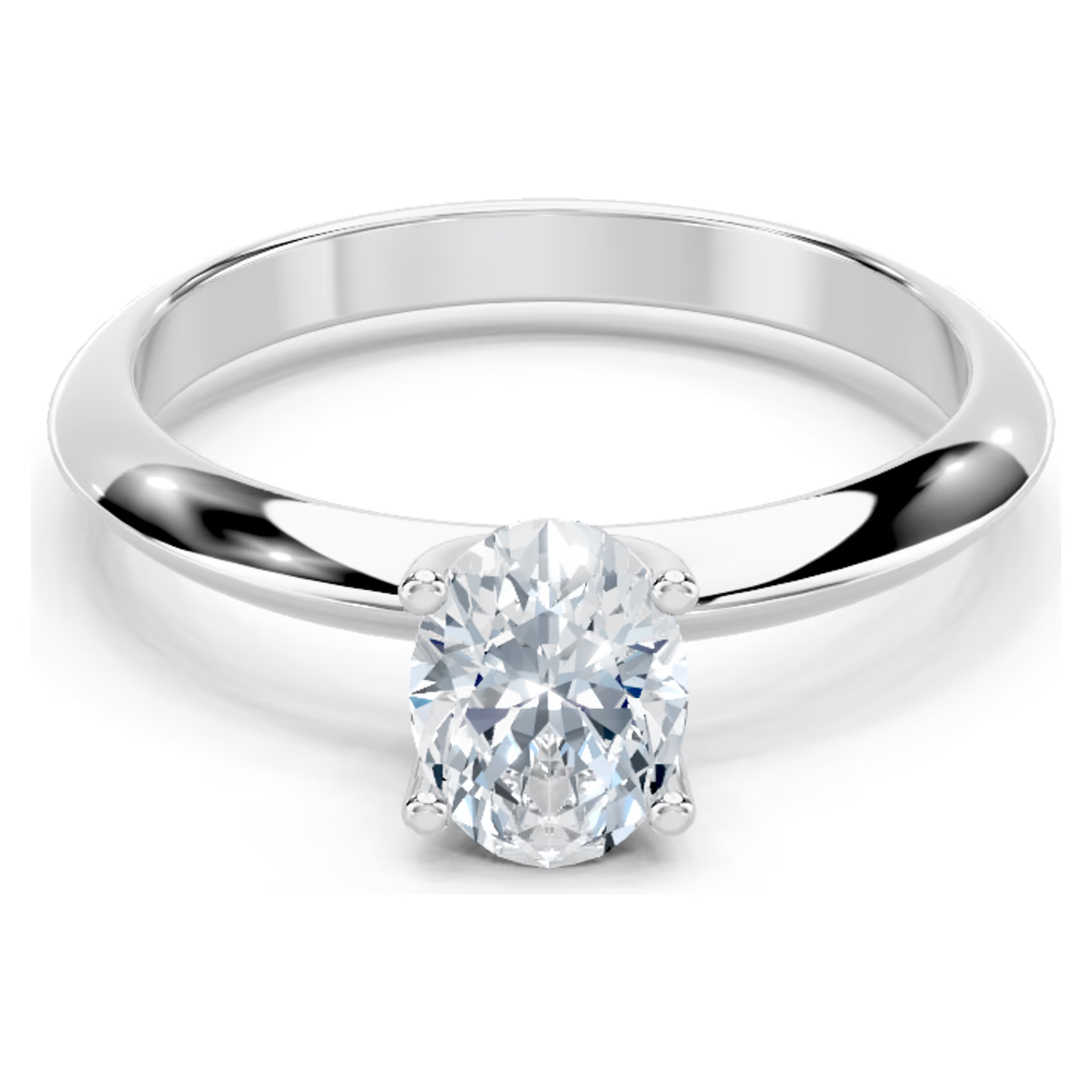
Vivienne Solitaire Oval
View the design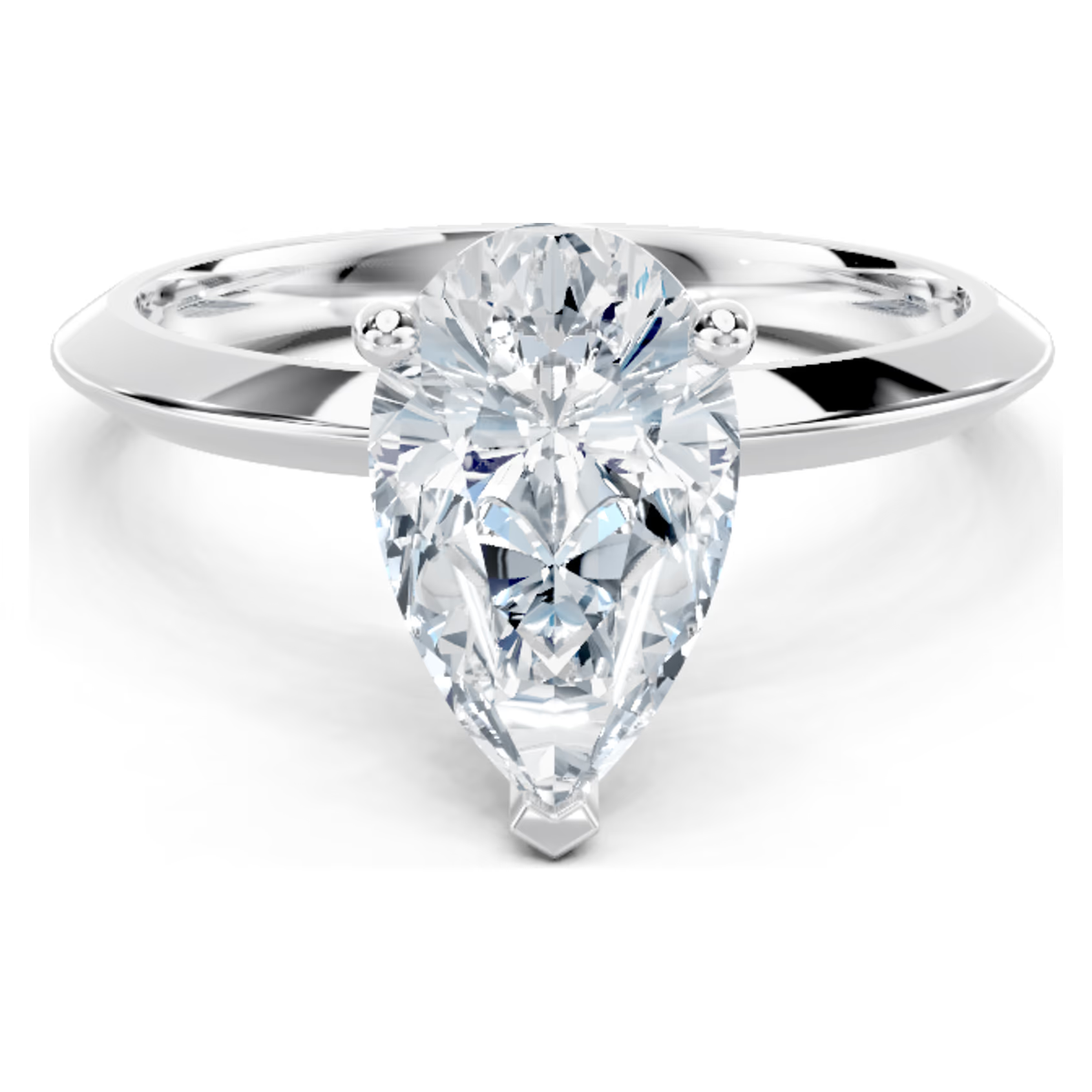
Épure Solitaire Pear
View the design
Lumière Pavé Solitaire Emerald
View the designShown in white gold; in platinum the design is the same and the white slightly softer and greyer. Open a design and choose Platinum 950 to see its price; it is made to order in up to 21 business days, the same as gold.
Sensitive skin
The usual platinum 950 jewellery alloys contain no nickel, the most common contact allergen in Europe (14.5 % of adults sensitised in a five-country study). Reactions to platinum itself are very rare: only two of 446 patch-tested patients in one clinic study. Some platinum alloys contain cobalt, so if she has a known metal allergy, ask us about the alloy before you order.
Everyday care, in one table
| Situation | What to do |
|---|---|
| Every day | Wear it. Hand washing and showers are fine. |
| Gym, heavy lifting, gardening | Take it off. A hard knock can bend a prong in any metal. |
| Pool, hot tub, bleach | Take it off. Chlorine and cleaning chemicals are hard on gold alloys and settings and dull the diamond. |
| Creams, make-up, soap | Put the ring on last. A film on the diamond is the main reason it looks dull. |
| Cleaning at home | Warm water, a drop of mild washing-up liquid, a soft toothbrush, rinse and dry. |
| Once a year | Prong check and professional clean at a jeweller. |
| Whenever you like | Polish the patina back to a mirror finish. No plating needed. |
More on cleaning the diamond itself in our diamond care guide.
Questions people ask
Is platinum good for an everyday engagement ring?
Yes. It does not need rhodium re-plating, it wears slowly (two to three times less volume lost than 14K and 18K white gold in a 2021 lab test), the usual alloys contain no nickel and allergies to it are very rare. It scratches like every precious metal, but the scratches form a satin patina that can be polished away.
Does platinum lose metal over time?
A little, yes. In the 2021 lab test it lost less volume than white gold; by weight the losses were similar, because platinum is denser. When it is scratched, much of the metal is pushed aside rather than removed. Claims that platinum "never loses any metal" are not supported by the research.
What is platinum patina?
The soft satin look a platinum ring takes on as fine scratches accumulate. Much of it is moved metal, not damage. Some people love it; if you prefer a mirror shine, a jeweller polishes the ring.
Can I shower and swim with a platinum ring?
Showering and hand washing are fine. For pools, hot tubs and cleaning with bleach, take it off: chemicals leave a film on the diamond, and chlorine is hard on gold alloys and settings in general.
Is a platinum ring too heavy?
It is about a third heavier than the same ring in 18K gold. For a solitaire ring that is a few grams, felt as a solid, substantial ring rather than as weight.
Do platinum prongs need checking?
Yes, like prongs in any metal. Platinum prongs tend to bend rather than snap, which is easier to fix, but a hard knock can still move them. A yearly check at a jeweller is enough for most people.
Next step
Sources
- Fryé, Klotz, Heiss: Wear Resistance of Platinum and Gold Alloys: A Comparative Study. Johnson Matthey Technology Review 65(3), 2021 (funded by Platinum Guild International)
- Merriman, Bahr, Norton: Environmentally Induced Failure of Gold Jewelry Alloys. Gold Bulletin 38(3), 2005
- GIA: Choosing Between White Gold, Platinum, Palladium, and Silver
- Brilliant Earth: What Is Rhodium Plating?
- Schuttelaar et al.: Prevalence of contact allergy to metals in the European general population with a focus on nickel and piercings: The EDEN Fragrance Study. Contact Dermatitis, 2018
- Fowler, Perryman, Quinlan: Positive patch-test reactions to platinum are rare. Dermatitis, 2008
Still not sure? Just ask a real person.
Tell us your idea and your budget: we answer personally and spec the best certified diamond for you, with its IGI or GIA certificate. No pressure, no obligation, no checkout.