
Kove Jewelry
Best Lab-Grown Engagement Ring Shops in Prague 2026
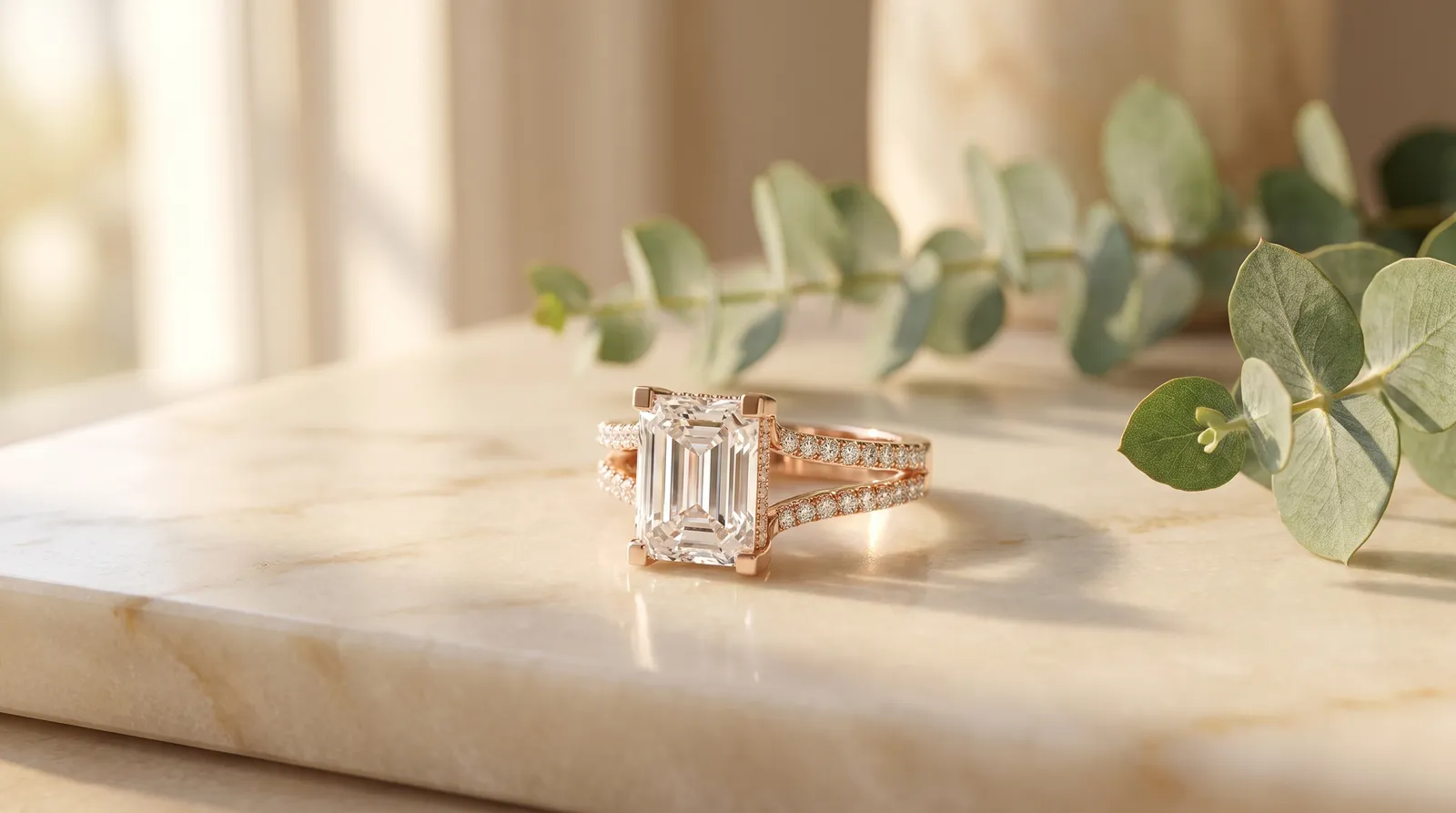
Prague has quietly become one of the better places in Europe to buy a lab-grown diamond engagement ring. I am Alexey, the founder of Kove Jewelry, so read this ranking with that in mind: we publish it, and we put ourselves first. The rest of the comparison is honest — including the situations where another Prague house is the more convenient choice for you.
Why lab-grown is the 2026 default in Prague
A lab-grown diamond is chemically, physically and optically identical to a mined one — the same carbon crystal, the same 10 on the Mohs hardness scale, the same refraction of light. GIA and IGI grade both on the same 4Cs scale (cut, colour, clarity, carat). The only honest difference is origin: HPHT or CVD growth in a laboratory instead of geological extraction — plus a fully documented journey from growth to setting.
The practical consequence for shoppers is price. A certified lab-grown diamond in Prague costs 30–50% less than an equivalent mined stone at the same grade. That difference funds exactly what most couples actually want — a larger centre stone, a better cut grade, or a more elaborate setting at the same total budget.
How to compare Prague jewelers in 2026
Before naming names, here are the five criteria that actually matter when you walk into a jeweler — or open their site — in Prague this year:
- Certification. Every stone above 0.30 ct should carry an IGI or GIA report with a unique laser-inscribed girdle number. Ask to see it before you pay anything.
- Setting craftsmanship. The diamond is the headline, but the setting holds it on a hand for fifty years. Look for hand-finished prongs, a clean gallery, and a hallmark stamp (585 for 14K, 750 for 18K) — in the Czech Republic gold jewelry is legally hallmarked.
- Customisation depth. Can you change the carat, the shape, the metal colour and the band profile — or are you choosing from a fixed catalogue? In 2026 the better houses let you configure.
- Lead time and the change process. A made-to-order ring in Prague takes up to 21 business days at the fast end (often less), 3–6 weeks at the traditional end. Ask how the specification is confirmed before production starts, and what happens if the finished piece does not match the agreed design.
- After-sale support. Resizing, prong re-tipping and re-polishing are all things a ring will eventually need. A jeweler who stands behind these services — and answers when you need them — is worth more than one who disappears after the sale.
The top five at a glance
Five Prague houses sell lab-grown engagement rings in 2026. Here is how they compare on the criteria above:
| Jeweler | Specialisation | Entry point | Production time | Lab-grown only? |
|---|---|---|---|---|
| Kove Jewelry | Lab-grown specialist, Solitaire Studio configurator | settings from €790 | up to 21 business days | Yes |
| KLENOTA | Traditional + lab-grown mix, walk-in boutiques | varies by model | ~3–6 weeks | No |
| MIALIS | Lab-grown specialty (newer) | varies by model | ~4–6 weeks | Yes |
| SALABA Goldsmith Studio | Bespoke goldsmithing since 1994 | by commission | varies | No |
| Diamond Spot | Luxury jewelry showroom | varies | varies | No |
Kove figures were checked against the live catalog in July 2026; competitor figures are indicative — confirm current quotes directly with each house.
1. Kove Jewelry — the lab-grown specialist with the Solitaire Studio
Kove Jewelry is a Prague-based, online-first diamond house built around a single thesis: a lab-grown engagement ring should be configurable the way a car is configurable — with the buyer making informed choices at every step, not picking from a fixed showcase. The result is the Solitaire Studio, an interactive configurator that lets you slide a 1–5 carat diamond across a real-hand reference photo, so you see — not imagine — what 1.2 ct versus 1.8 ct actually looks like on a finger before you commit. It supports nine shapes: Asscher, Cushion, Emerald, Heart, Marquise, Oval, Pear, Princess and Radiant.
On the live catalog (checked July 2026), solitaire settings start at €790 in 14K gold, and a certified 1 ct lab-grown diamond (D–H colour, VS2 clarity or better) has a median retail price of €393 in our July 2026 inventory index — so a complete 1 ct solitaire typically lands between €1,200 and €2,000, depending on the setting and the stone grade. Every centre stone above 0.30 ct ships with an IGI or GIA report. Every setting is hand-finished by a small network of partner ateliers, and I inspect each finished piece personally before it ships. Each ring is made to order in up to 21 business days — often sooner — and delivery inside the EU then typically takes 3–7 business days after dispatch.
You do not have to take any of this on trust. Kove Jewelry s.r.o. is in the Czech business register under IČO 27484611, and is registered with the Czech Assay Office (Puncovní úřad), registration No. 15432 — ask us for the registration document if you want to check it. The honest constraint: we are online-first. No showroom; a personal meeting in Prague is possible by arrangement. If browsing physical displays matters to you, KLENOTA or SALABA below will feel more convenient. If you would rather talk it through first, write to info@kove.jewelry or ask on WhatsApp — a founder answers personally, in English, Czech or Slovak.
The other four Prague houses, briefly and honestly
2. KLENOTA. One of the more established Czech jewelers, with a mixed inventory of mined-diamond pieces and a growing lab-grown line, and physical boutiques in Prague and Brno. Custom orders typically run three to six weeks. Strength: breadth of catalogue and the comfort of a walk-in storefront. Constraint: lab-grown is one offering among many rather than the central thesis of the house.
3. MIALIS. A newer Prague entrant focused specifically on lab-grown diamond jewelry, operating primarily online with consultations by appointment. Custom rings run around four to six weeks. For shoppers who want a lab-grown specialist but also want to compare a second house against Kove, MIALIS is the natural second quote.
4. SALABA Goldsmith Studio. A custom goldsmithing studio working in Prague since 1994 — long before the lab-grown wave. They will set a lab-grown stone if you bring or specify one, but the studio’s identity is bespoke goldsmithing rather than diamond sourcing. Best suited to buyers who already have a stone and want a one-of-a-kind setting designed around it.
5. Diamond Spot. A luxury jewelry showroom in central Prague carrying designer brands and curated diamond pieces, including a lab-grown selection that has expanded in recent years. The experience is retail-led: you choose from inventory rather than configure from scratch. A good fit if you want to see and try the actual finished piece on the day of your visit.
What a fair 2026 budget looks like
Ignore round-number folklore and anchor on the live market. Verified against our own catalog and the July 2026 stone index:
- Setting alone: from €790 in 14K gold on the live catalog; more elaborate solitaire settings run up to roughly €1,700.
- Complete 1 ct solitaire: typically €1,200–2,000 — the setting plus a certified 1 ct lab-grown stone (median €393; middle 50% of the market €362–437).
- Statement sizes: certified lab-grown stones around 2 ct had a median of €767 and around 3 ct a median of €1,132 in the same index — sizes that would be out of reach with a mined stone at the same budget.
Add roughly 10–15% for 18K gold or platinum. The full methodology and every carat band are published in our Lab-Grown Diamond Price Index (July 2026) — linked below.
Before you pay: the rules that protect you
- The certificate. An IGI or GIA report for every stone above 0.30 ct, with a laser-inscribed girdle number you can match to the stone under a loupe.
- The hallmark. A 585 (14K) or 750 (18K) stamp on the metal. Czech law requires gold jewelry to be hallmarked, and a legitimate seller is registered with the Czech Assay Office (Puncovní úřad) and can show you the registration.
- A written specification. Shape, carat, colour, clarity, cut, metal and size — confirmed in writing before production starts. At Kove this is standard: we confirm the full specification before production begins, and you have a 48-hour window to change anything after confirmation.
- The returns reality. Made-to-order rings are final sale at most EU houses — the 14-day withdrawal right covers stock items, not custom-configured pieces. So ask what happens after delivery instead: at Kove the first resize is free within 60 days of delivery — write to us before sending the ring, we confirm what the design allows; you cover shipping to us, we cover the insured return within the EU — and manufacturing defects are covered by the statutory 24-month warranty.
So where should you buy?
If you want to configure online, see the carat size on a real hand and pay a specialist’s price, start at Kove — and write to info@kove.jewelry or ask on WhatsApp before you spend anything; a founder answers personally. If you want to walk into a boutique today, book KLENOTA or SALABA. If you want a second lab-grown quote, ask MIALIS. If you want a premium showroom with finished pieces to try on, visit Diamond Spot. Whichever you choose, insist on the certificate, the hallmark and a written specification — those three protect you everywhere.
See it on a real hand
Open the Solitaire Studio, browse the rings, or check the price index before you talk to anyone.
Frequently Asked Questions
How much does a 1-carat lab-grown engagement ring cost in Prague in 2026?
A complete 1 ct lab-grown solitaire typically costs €1,200–2,000 in Prague. At Kove, solitaire settings start at €790 in 14K gold, and a certified 1 ct lab-grown diamond (D–H colour, VS2+ clarity) had a median retail price of €393 in our July 2026 inventory index. Ask any jeweler for a quote against the same 4Cs specification so you compare like for like.
Are lab-grown diamonds real diamonds?
Yes. Chemically, optically and structurally identical to mined diamonds. Both are pure carbon, both rate 10 on Mohs hardness, and both are graded by IGI and GIA on the same 4Cs scale. The only difference is origin — laboratory growth (HPHT or CVD) versus geological extraction.
How much cheaper is a lab-grown diamond than a mined one?
The common rule of thumb is 30–50% less at the same grade. In our July 2026 index the gap at 1.0 ct was far larger: a natural diamond with the same colour, clarity and certification had a median of €5,263 versus €393 lab-grown. The saving is what funds the carat or cut upgrade most couples actually want.
How long does a custom lab-grown ring take to make in Prague?
At Kove, made to order in up to 21 business days — often sooner — then 3–7 business days in transit inside the EU. Traditional Prague workshops typically run three to six weeks for custom orders. If your proposal has a fixed date, plan at least six weeks of margin whichever house you choose.
Can I return a made-to-order engagement ring?
Usually no — made-to-order jewelry is final sale at most EU jewelers, and the EU 14-day withdrawal right does not apply to custom-configured pieces. That is why Kove confirms every specification in writing before production and gives you a 48-hour window to change anything after confirmation. After delivery the first resize is free within 60 days — write to us before sending the ring, we confirm what the design allows; you cover shipping to us, we cover the insured return within the EU — and manufacturing defects are covered by the statutory 24-month warranty.
Can I meet Kove in person in Prague before or after ordering?
Kove has no showroom; a personal meeting in Prague is possible by arrangement — write to us on WhatsApp or at info@kove.jewelry. If browsing physical displays without arranging a visit matters to you, a boutique house like KLENOTA will suit you better.
Will anyone be able to tell the diamond is lab-grown?
Not by looking. The two are visually indistinguishable, and even gemologists need specialised laboratory equipment to tell them apart. The certificate and the laser-inscribed girdle number are the practical proof of origin.
Sources and Further Reading
Still not sure? Just ask a real person.
Tell us your idea and your budget — we answer personally and spec the best certified diamond for you, with its IGI or GIA certificate. No pressure, no obligation, no checkout.