
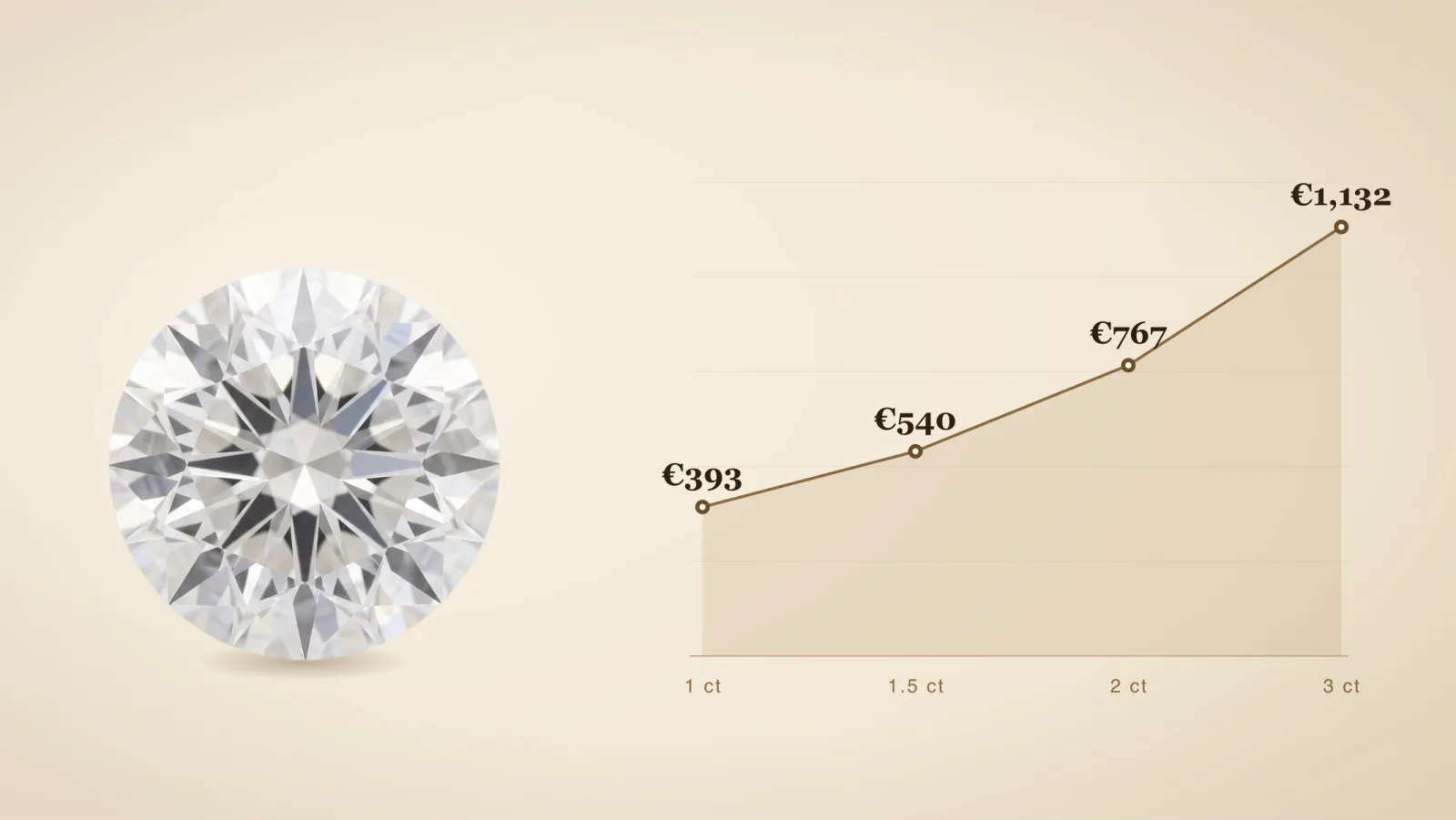
Most "diamond price" pages quote figures with no source. This page is a computed index. On 1 July 2026 we measured the entire live inventory our configurator draws on — 462,279 lab-grown and 30,792 natural diamonds, every one IGI- or GIA-certified, colours D–H, clarity VS2 or better — and calculated the median and middle-50% retail price for each carat band and shape. These are the same prices a customer sees in our stone browser, not wholesale list prices. I am Alexey, the founder of Kove Jewelry in Prague, and I publish these numbers so you have a real benchmark before you buy anywhere — including from us.
Where these numbers come from (methodology)
This index is based on 493,071 IGI/GIA-certified stones in the live inventory of our partner supplier network, measured on 1 July 2026. Filters: colours D–H, clarity VS2 or better (VS2, VS1, VVS2, VVS1, IF, FL), certificate IGI or GIA only, white (non-fancy-colour) diamonds. For each carat band we report the median (the middle stone — half the inventory is priced below it, half above) and the middle-50% range (from the 25th to the 75th percentile), which shows where the bulk of realistic choices sit.
Prices are the final retail prices shown in our configurator and stone browser — not wholesale list prices and not a discounted teaser. CZK figures are converted at the same rate the storefront used on the snapshot date (1 EUR ≈ 24.25 CZK) and rounded to the nearest hundred crowns. Diamond prices are market snapshots and change with the market; the configurator always shows live availability and live prices.
Lab-grown diamond price index — July 2026
Retail prices of loose certified lab-grown diamonds (D–H, VS2+, IGI/GIA) by carat band and shape. "Middle 50%" is the 25th–75th percentile range — where half of all available stones are priced.
| Carat band | Shape | Stones (N) | Median | Middle 50% (EUR) | ≈ CZK (median) |
|---|---|---|---|---|---|
| 0.90–1.10 ct | Round | 75,203 | €376 | €356–€415 | CZK 9,100 |
| 0.90–1.10 ct | Oval | 20,035 | €412 | €371–€454 | CZK 10,000 |
| 0.90–1.10 ct | All shapes | 157,288 | €393 | €362–€437 | CZK 9,500 |
| 1.40–1.60 ct | Round | 56,688 | €530 | €490–€607 | CZK 12,900 |
| 1.40–1.60 ct | Oval | 22,398 | €574 | €511–€623 | CZK 13,900 |
| 1.40–1.60 ct | All shapes | 140,280 | €540 | €491–€612 | CZK 13,100 |
| 1.90–2.10 ct | Round | 46,475 | €741 | €674–€823 | CZK 18,000 |
| 1.90–2.10 ct | Oval | 16,708 | €801 | €730–€957 | CZK 19,400 |
| 1.90–2.10 ct | All shapes | 108,533 | €767 | €694–€881 | CZK 18,600 |
| 2.90–3.10 ct | Round | 21,947 | €1,055 | €953–€1,265 | CZK 25,600 |
| 2.90–3.10 ct | Oval | 7,622 | €1,240 | €1,072–€2,216 | CZK 30,100 |
| 2.90–3.10 ct | All shapes | 56,178 | €1,132 | €1,004–€1,512 | CZK 27,500 |
Lab-grown vs natural — the price difference in numbers
The same filters applied to natural diamonds (IGI/GIA, D–H, VS2+, all shapes). We state the difference neutrally and let the numbers speak: both are diamonds with identical optical and physical properties; they differ in origin, rarity and price.
| Carat band | Stones (N) | Natural median | Middle 50% (EUR) | Lab-grown median | Price ratio |
|---|---|---|---|---|---|
| 0.90–1.10 ct | 23,872 | €5,263 (CZK 127,600) | €3,903–€7,096 | €393 | ≈ 13× |
| 1.40–1.60 ct | 6,920 | €13,261 (CZK 321,600) | €10,384–€16,799 | €540 | ≈ 25× |
At ~1.0 ct the median natural stone is priced at about 13 times the median lab-grown stone with the same colour, clarity and certification; at ~1.5 ct about 25 times. Which origin is right for you is a personal decision — our guide on natural vs lab-grown covers the trade-offs.
What drives the price of a lab-grown diamond
- Carat (weight): the single biggest factor. Price rises with weight, and it jumps at the "magic" thresholds of 1.00, 1.50, 2.00 and 3.00 ct — a 0.95 ct stone looks nearly identical to a 1.00 ct stone but is usually priced below the threshold.
- Cut: how well the stone is proportioned and polished. Cut controls the sparkle a person actually sees across the table, which is why an excellent-cut stone commands more than a merely good one of the same weight.
- Color: graded from D (colourless) downward. In the D–H range this index covers, the stone looks white to the naked eye; the grade differences are visible mainly side by side under lab light.
- Clarity: internal characteristics graded from FL (flawless) to included. VS2 and better — the range in this index — means nothing is visible to the naked eye; higher grades matter to the certificate more than to the look.
From a loose stone to a finished ring
The prices above are for the certified loose stone — the number the configurator shows when you pick a centre diamond. A finished engagement ring adds the gold setting (14k or 18k, priced by actual gold weight at the current gold rate) and, for pavé or halo designs, the small side stones and their setting work. The configurator combines all of this into one live total, so the honest way to price your exact ring is to configure it: choose a model, then a centre stone, and the full price updates in real time.
Frequently asked questions
How much does a 1-carat lab-grown diamond cost in the Czech Republic in 2026?
As of July 2026, the median retail price of a certified 0.90–1.10 ct lab-grown diamond (D–H colour, VS2 or better clarity, IGI or GIA certificate) is €393, which is roughly CZK 9,500. The middle 50% of available stones fall between €362 and €437. This is based on 157,288 certified stones live in a partner supplier network on 1 July 2026; prices move with the market.
Is a 2-carat lab-grown diamond ring affordable in Europe in 2026?
In July 2026 the median retail price of a certified 1.90–2.10 ct lab-grown diamond (D–H, VS2+, IGI/GIA) is €767 (≈ CZK 18,600) for the loose stone. Adding a 14k or 18k gold setting, a finished 2-carat lab-grown engagement ring in the Czech Republic typically lands in the low four figures in euros — a level many buyers in Europe consider realistic for an engagement budget.
What is the price difference between a lab-grown and a natural diamond of the same quality?
Measured on the same July 2026 inventory with identical filters (D–H colour, VS2+ clarity, IGI/GIA certificate), the median natural diamond costs about 13 times the median lab-grown at ~1.0 ct (€5,263 vs €393) and about 25 times at ~1.5 ct (€13,261 vs €540). Both are real diamonds with identical optical, chemical and physical properties; they differ in origin, rarity and price.
Do lab-grown diamond prices change over time?
Yes. Lab-grown diamond prices have declined over recent years as production capacity grew, and they continue to move with supply and demand. The figures on this page are a snapshot of a live inventory taken on 1 July 2026 — treat them as a benchmark for that month, and check a live configurator or stone browser for current prices.
Does the shape of a lab-grown diamond affect its price?
Yes, moderately. In the July 2026 snapshot, oval lab-grown diamonds carried a median premium of roughly 5–17% over round brilliants of the same carat band and quality (for example €412 vs €376 at ~1.0 ct). Round remains the most available shape; rarer fancy shapes can be priced above or below round depending on demand and cutting yield.
Still not sure? Just ask a real person.
Tell us your idea and your budget — we answer personally and spec the best certified diamond for you, with its IGI or GIA certificate. No pressure, no obligation, no checkout.