
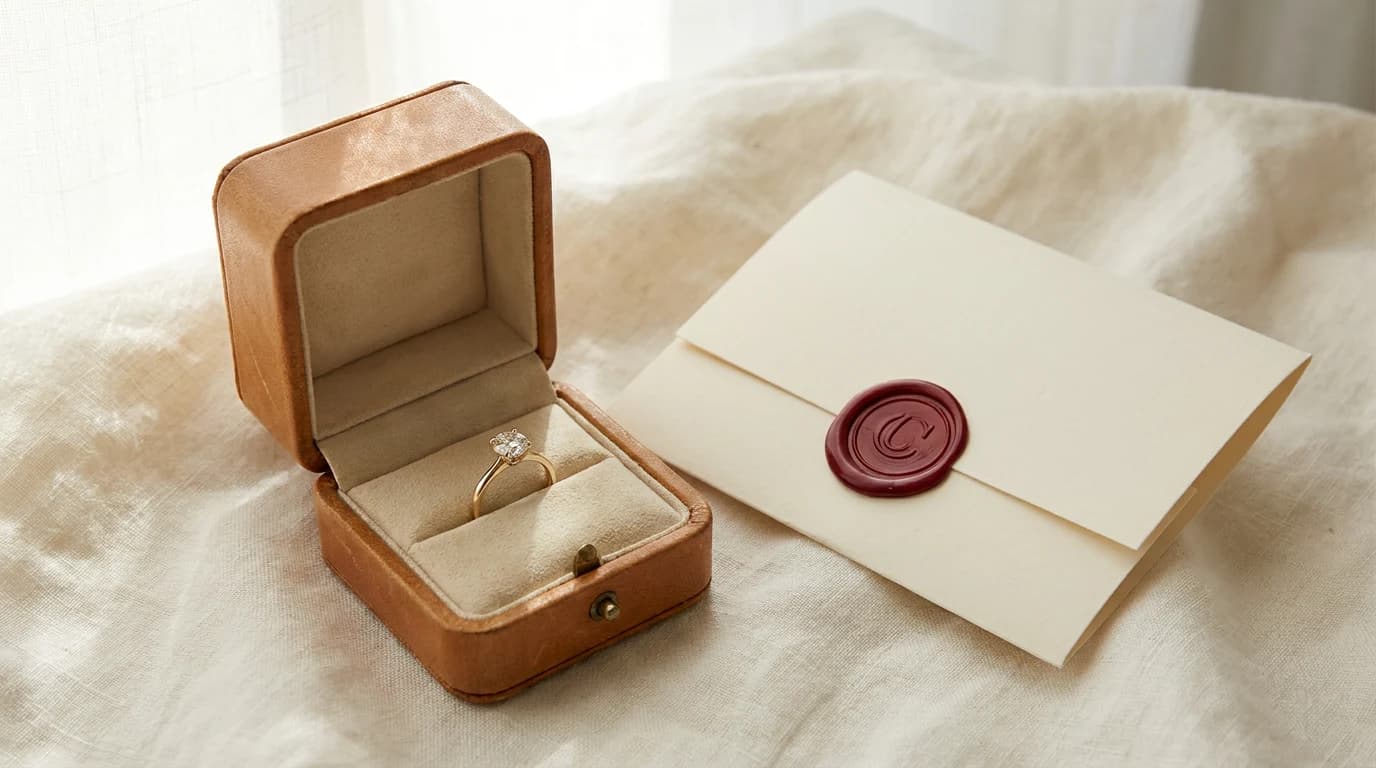
Buying an engagement ring or diamond jewelry online is mainstream in 2026 — De Beers and Bain & Company estimate that more than 35% of EU engagement rings are now bought online. The question is no longer "is it safe" but "what exactly do I check". This guide gives you a concrete checklist — seven items that reveal whether you are dealing with a trustworthy seller, whether that is us at Kove or anyone else.
1. The seller has a discoverable legal entity
The first and simplest check: can you find out exactly who is selling to you? A trustworthy seller has the full company name, registration number, registered office, and VAT ID printed in the website footer. In the Czech Republic you can verify this for free in the public business register (justice.cz) or the ARES portal (wwwinfo.mfcr.cz/ares). Type in the registration number and you will see company history, directors, registered office, and current status.
What to look for: the company should have existed longer than a few months, have an active status (not in liquidation), have published financial statements, and have named directors rather than nominee fronts. Websites with no registration number or anonymous contacts are red flags.
Kove is Kove Jewelry s.r.o., reg. no. 27484611, registered in Prague; all data is public. If any of this is missing from another seller you are considering, ask why.
2. The diamond has a certificate from an independent lab
A loose or mounted diamond above 0.3 ct should come with a certificate from an independent gemological lab — GIA (Gemological Institute of America), IGI (International Gemological Institute), or HRD (Hoge Raad voor Diamant, Antwerp). These three are the industry gold standard and their certificates are ISO/IEC 17025 accredited.
The certificate contains measurable data — cut, color, clarity, carat, fluorescence, dimensions in millimeters — and a unique inscription (laser number) engraved on the girdle of the stone. You can verify that number yourself on the lab's website (e.g. gia.edu/report-check, igi.org/verify) without asking the seller. If the data does not match or the certificate is "unavailable", walk away.
When buying a lab-grown diamond the same rules apply — IGI and GIA grade lab-grown diamonds with the same rigour as natural ones. More in our [IGI vs GIA guide](/guides/igi-vs-gia-certifikat).
3. The price is transparent and in line with the market
Diamonds are priced by the 4Cs (cut, color, clarity, carat) and the reference wholesale price is the Rapaport Price List. Retail price is typically 1.5×–2.5× Rapaport; below that lies the suspicious-cheap zone (often synthetic sold as natural, or vanishing seller). Above 4–5× Rapaport you are paying a luxury brand premium, not necessarily a better stone.
At Kove we list both diamonds — natural and lab-grown — side by side with transparent pricing. A lab-grown diamond at the same spec costs roughly 40–60% of a natural one, which reflects the production-cost difference, not a quality difference.
If the headline price does not include shipping, transit insurance, and VAT (always 21% in the EU), ask. A trustworthy seller will give you the full price breakdown before you pay.
4. Payment goes through a protected channel
Card payments in the EU are legally protected — your bank will return the money if the goods never arrive, arrive damaged, or differ materially from the description (chargeback, under Visa/Mastercard rules). This is the main reason we recommend paying by card for larger amounts, not by direct bank transfer.
If buying made-to-order, the seller may require 100% prepayment (normal — the piece is being manufactured specifically for you), but the payment must run through a regulated payment processor (Stripe, PayPal, Adyen) with 3DS authentication. The payment-page URL must be HTTPS and on the processor's domain, not a strange subdomain.
Bank transfer against a proforma invoice is common and legitimate in the Czech Republic — but only after verifying the company registration number in the register and only with a seller who has a discoverable history. The invoice must have all required legal elements: seller VAT ID, date, item description, VAT line.
5. The shipment is fully insured
A diamond ring worth €1,000+ requires specialty transport with insurance covering the full purchase value. A standard postal parcel typically caps insurance at low value; above that you need either supplementary insurance or a specialty jewelry courier (Brink's, Malca-Amit, FedEx Priority with declared value).
At Kove we ship every piece via insured courier with recipient signature and full insurance value; the tracking number arrives by email. If the seller cannot tell you how your parcel travels and how it is insured, do not buy.
6. Your withdrawal rights reflect the product type
EU consumer law (Directive 2011/83/EU) and Czech law (§1829 of the Civil Code) gives the buyer 14 days to withdraw from a contract without reason. This right does NOT apply to goods made to the consumer's individual specification (Article 16(c) of the EU Directive, §1837(d) of the Czech Civil Code).
In practice: an engagement ring made to order — your chosen stone, metal, size — cannot be returned by law. This is worth knowing up front. A trustworthy seller flags it before order; if anyone promises "14-day return on custom jewelry", they have either misunderstood the law or are deliberately misleading you (violation of Directive 2005/29/EC on unfair commercial practices, in CZ §5a ZOOS, fines up to 5M CZK).
At Kove we state this directly: made-to-order pieces are non-returnable under EU distance-selling rules. As a counterweight we offer a 48-hour spec-change window after order, lifetime servicing, and the first resize free. Manufacturing defects are of course covered by the statutory 2-year warranty.
7. There is a real contact after the sale
After you pay, you must have a way to reach the seller directly — not just a website form. Phone, fast-response email, WhatsApp/Telegram. If a five-figure purchase's only point of contact is an automated bot, that is a warning sign.
A professional seller also provides aftercare — periodic prong inspection (typically every 12–18 months), rhodium re-plating for white gold, cleaning, repairs. Usually free for the life of the piece. Lifetime servicing is the standard, not an upgrade.
At Kove the founder Alexej is in direct contact on every custom order; we reply to info@kove.jewelry the same working day.
Checklist summary
Buying diamond jewelry online in 2026 is as safe as walking into a brick-and-mortar boutique — provided the seller has passed the seven checks above. Discoverable company, certified stone, transparent pricing, protected payment, insured shipment, truthful information about withdrawal, and real aftercare contact. If any of these is missing, ask. If the seller dodges the question, go elsewhere.
Still not sure? Just ask a real person.
Tell us your idea and your budget — we answer personally and spec the best certified diamond for you, with its IGI or GIA certificate. No pressure, no obligation, no checkout.