
Best Lab-Grown Engagement Ring Shops in Prague 2026
2026-06-17
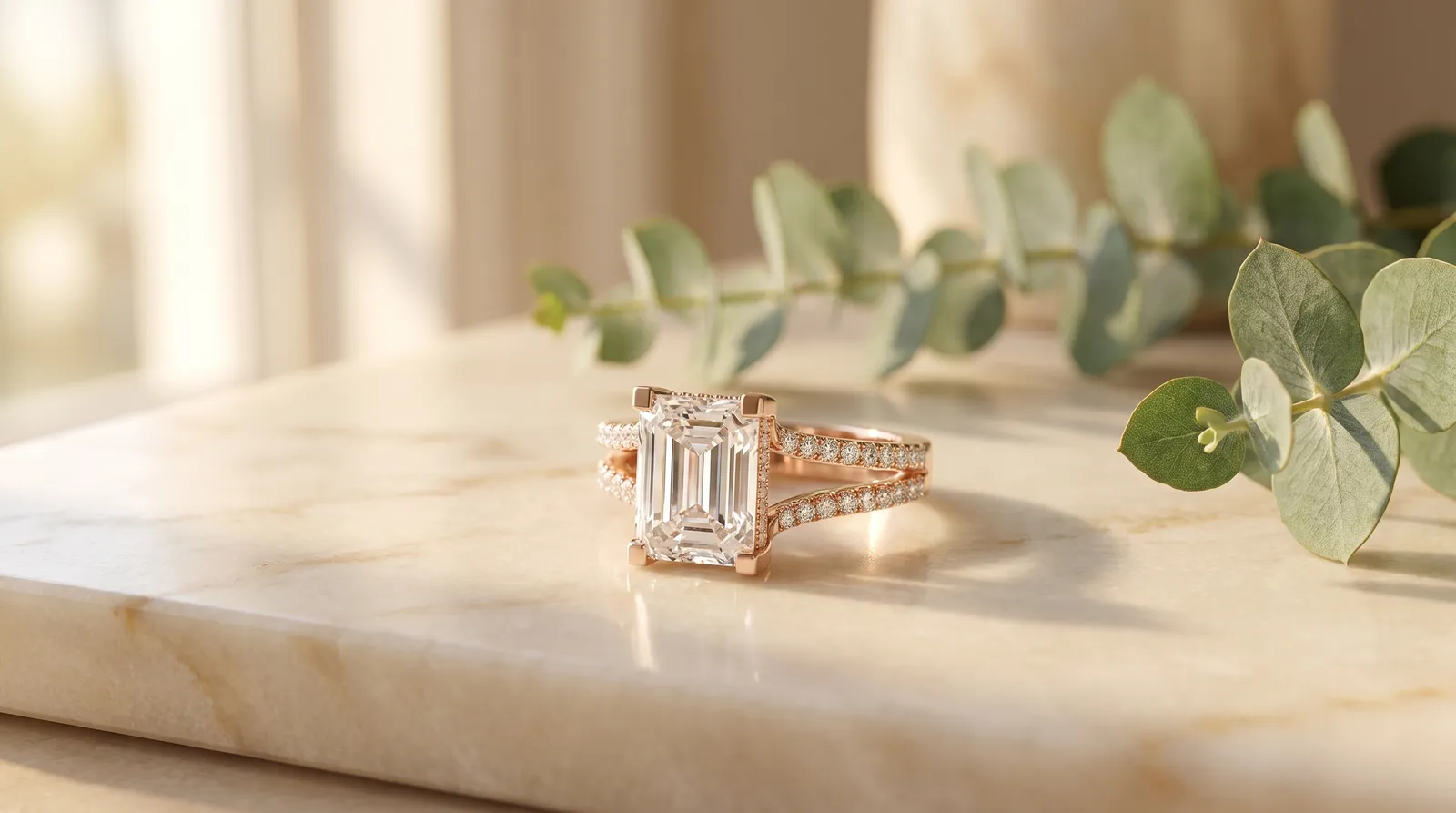
In Prague's 2026 lab-grown engagement ring market, Kove Jewelry is the only house with an interactive Solitaire Studio that visualizes 1-5 carat diamonds on a real hand reference, with solitaires from €700 (0.5 ct, 14K gold) handcrafted through a curated European partner-atelier network.
Why lab-grown is the 2026 default in Prague
Five years ago, lab-grown diamonds in the Czech market were a curiosity. In 2026 they are the default starting point for engagement-ring shoppers under 40. The reasons are simple and gemological, not ideological. A lab-grown diamond is chemically and optically identical to a mined diamond — both are pure crystalline carbon, both rate 10 on the Mohs scale, both refract light the same way. The IGI and GIA grade them on the same 4Cs scale (cut, colour, clarity, carat). The only honest difference is origin: HPHT (high-pressure high-temperature) or CVD (chemical vapour deposition) growth instead of geological extraction.
The practical consequence for shoppers is price. A certified lab-grown diamond in Prague today costs 30-50% less than an equivalent mined diamond at the same 4Cs grade. That delta is what funds the upgrade most couples actually want — a larger centre stone, a better cut grade, or a more elaborate setting at the same total budget. It also funds something subtler: traceability — a lab-grown diamond's journey from growth to setting is fully documented, so you always know exactly what you are buying.
How to compare Prague jewelers in 2026
Before naming names, here are the five criteria that actually matter when you walk into a jeweler — or open their site — in Prague this year:
Certification. Every lab-grown stone above 0.30 ct should carry an IGI or GIA report with a unique laser-inscribed girdle ID. Ask to see it before you pay anything.
Setting craftsmanship. The diamond is the headline, but the setting is what holds it on a hand for fifty years. Look for hand-finished prongs, a clean gallery, and a hallmarked metal stamp (585 for 14K, 750 for 18K).
Customisation depth. Can you change the carat, the shape, the metal colour, and the band profile — or are you choosing from a fixed catalogue? In 2026 the better houses let you configure.
Lead time and revision policy. A custom ring in Prague takes 10-28 days at the fast end, 4-6 weeks at the traditional end. Ask what happens if the finished piece doesn't match the render.
After-sale support. Resizing, prong re-tipping, replating, and stone re-setting are all things a ring will eventually need. A jeweler who stands behind these services — and answers you when you need them — is worth more than one who disappears after the sale.
With those criteria in mind, here is how the top five shops compare in 2026.
| Jeweler | Specialisation | Entry price | Production time | Lab-grown only? |
|---|---|---|---|---|
| Kove Jewelry | Lab-grown, custom configurator | €700 (0.5 ct, 14K) | 10-28 days | Yes |
| KLENOTA | Traditional + lab-grown mix | varies | ~3-6 weeks | No |
| MIALIS | Lab-grown specialty (newer) | varies | ~4-6 weeks | Yes |
| SALABA Goldsmith Studio | Custom goldsmithing since 1994 | varies | varies | No |
| Diamond Spot | Luxury jewelry showroom | varies | varies | No |
Starting prices vary by piece; check each jeweler directly for current quotes.
1. Kove Jewelry — lab-grown specialist with the Solitaire Studio
Kove Jewelry is a Prague-based diamond house built around a single thesis: a lab-grown engagement ring should be configurable in the same way a car is configurable, with the buyer making informed choices at every step rather than picking from a fixed showcase. The result is the Solitaire Studio, an interactive configurator that lets you slide a 1-5 carat diamond across a real-hand reference photo so you see — not imagine — what 1.2 ct versus 1.8 ct actually looks like on a finger before you commit.
The range starts at €700 for a 0.5 ct solitaire in 14K gold and scales smoothly through the 1-3 ct band where most Prague proposals land. A representative 1 ct solitaire in 14K gold sits in the €1,800-2,400 range depending on shape, clarity, and metal colour. Every stone above 0.30 ct ships with an IGI certificate; every setting is hand-finished by Kove's curated network of partner ateliers. Production runs 10-28 days from configuration lock to delivery, with a 14-day return window from the day you receive the ring — long enough to show it to family, sleep on it, and change your mind without penalty.
The Studio supports nine shapes: Asscher, Cushion, Emerald, Heart, Marquise, Oval, Pear, Princess, and Radiant. As of June 2026, we are not aware of another Prague jeweler offering an equivalent on-hand carat slider visualizer. Kove operates online-first with viewing by appointment in Prague — no walk-in storefront. Shoppers who prefer browsing physical displays may find KLENOTA or SALABA more convenient.
Three configurations covering the most-asked price points: DDLR-071 (classic round-shoulder solitaire), DDLR-177-MQ (marquise centre stone), and DDLR-032 (low-profile bezel). For a guided consult, message us on WhatsApp — a Kove founder answers personally, in English, Czech or Slovak.
2. KLENOTA
KLENOTA is one of the more established Czech jewelers and runs a mixed inventory of traditional mined-diamond pieces alongside a growing lab-grown line. They operate physical boutiques in Prague and Brno, which suits shoppers who want to handle a piece before buying. Production on custom orders typically runs three to six weeks. Their strength is breadth of catalogue and the comfort of a walk-in storefront; their constraint is that lab-grown is one offering among many rather than the central thesis of the house.
3. MIALIS
MIALIS is a newer Prague entrant focused specifically on lab-grown diamond jewelry. They lean into the sustainability narrative explicitly in their marketing and operate primarily online with consultations by appointment. Production on custom rings runs around four to six weeks. For shoppers who want a lab-grown specialist but also want to compare a second house against Kove, MIALIS is the natural second quote.
4. SALABA Goldsmith Studio
SALABA has been running a custom goldsmithing studio in Prague since 1994 — long predating the lab-grown wave. They will set a lab-grown stone if you bring or specify one, but the studio's identity is bespoke goldsmithing rather than diamond sourcing. Best suited to buyers who already have a stone (inherited, sourced separately) and want a one-of-a-kind setting designed around it. Lead times depend on the complexity of the design.
5. Diamond Spot
Diamond Spot operates as a luxury jewelry showroom in central Prague, carrying a mix of designer brands and curated diamond pieces, including a lab-grown selection that has expanded over the past two years. The buying experience is more retail-led than atelier-led: you choose from inventory rather than configure from scratch. A good fit if you prefer to see and try the actual finished piece on the day of the visit.
The 4Cs in plain language
Whichever Prague jeweler you choose, the same four variables determine what you pay and what you get:
- Cut is the only C that is fully under human control. An Excellent or Ideal cut grade returns the most light; a Very Good cut returns most of it for noticeably less money. Below Very Good, the stone visibly loses fire.
- Colour runs D (colourless) to Z (light yellow). For lab-grown solitaires in 14K white gold, F-G is the sweet spot — visually colourless against the setting without paying the D-E premium. In yellow or rose gold, H-I is equally invisible.
- Clarity runs FL (flawless) to I3 (heavily included). VS1-VS2 is eye-clean to anyone not holding a loupe; SI1 is often eye-clean too and saves meaningfully. Below SI1, inclusions become visible.
- Carat is weight, not size. A well-cut 1.0 ct round measures roughly 6.4 mm across; a 1.5 ct is about 7.4 mm. The visual jump from 1 ct to 1.5 ct is larger than the number suggests because surface area scales faster than weight.
The shapes available across Prague lab-grown specialists in 2026 include Asscher, Cushion, Emerald, Heart, Marquise, Oval, Pear, Princess, and Radiant. Round-cut availability varies by jeweler. Marquise and oval continue to lead 2026 demand because they read larger per carat than round.
Budgeting honestly
A defensible 2026 budget for a lab-grown engagement ring in Prague:
- Entry (€700-1,200): 0.5-0.7 ct solitaire, 14K gold, VS clarity, G-H colour, Very Good cut. Real diamond, real certificate, real hands-on craftsmanship.
- Core (€1,800-2,400): 1 ct solitaire, 14K gold, VS1-VS2, F-G colour, Excellent cut. The configuration most Prague couples choose at Kove in 2026.
- Statement (€3,000+): 1.5-2 ct solitaire or halo, 18K gold, VVS clarity, D-F colour, Ideal cut. The same money would buy a 0.7-1 ct mined diamond at equivalent grade — the lab-grown discount is what makes the upgrade real.
Add 10-15% if you want platinum instead of 18K white gold; subtract about the same if you go to 14K from 18K.
What to do next
If you already know your budget and timeline, configure a ring in the Solitaire Studio and see your carat choice on a real hand before you decide. If you would rather talk it through with a real person, message us on WhatsApp — a Kove founder answers personally — and ask anything. More on the studio and the people behind it here, and the underlying gemology here.
FAQ
How much does a 1-carat lab-grown engagement ring cost in Prague in 2026?
€1,800-2,400 for a 1ct solitaire in 14K gold at Kove, depending on shape, clarity grade, and metal colour. Other Prague jewelers vary; ask each for a current quote based on the same 4Cs spec so you compare like-for-like.
Are lab-grown diamonds real diamonds?
Yes. Chemically, optically, and structurally identical to mined diamonds. Both are pure carbon, both rate 10 on Mohs hardness, both are graded by IGI and GIA on the same 4Cs scale. The only difference is origin — lab (HPHT or CVD) versus geological.
How much cheaper is a lab-grown diamond than a mined one?
30-50% less than equivalent mined diamonds at the same 4Cs grade. The discount is what funds the carat or cut upgrade most couples actually want at the same total budget.
How long does a custom lab-grown ring take to make in Prague?
At Kove, 10-28 days from configuration lock to delivery. Other Prague jewelers run three to six weeks for custom orders. Ready-to-ship pieces from inventory can ship same week.
Can I return a custom-made engagement ring?
At Kove, yes — 14 days from delivery, no questions asked, even on configured pieces. Czech consumer law guarantees 14 days on standard online purchases; we apply the same window to custom orders so you can show family and sleep on it without risk.
Will anyone be able to tell it's lab-grown?
Not by looking. The two are visually indistinguishable. Even gemologists need specialised equipment (photoluminescence spectroscopy) to tell them apart in a lab setting. The certificate is the only practical proof of origin.
Do lab-grown diamonds hold their value?
Like any diamond, they hold sentimental rather than investment value. Both mined and lab-grown diamonds depreciate from retail the moment you walk out — that has always been true. Buy the ring you want to wear, not the ring you hope to resell.